Proposition 18.4.2. Let \(D\) be a compactly generated category and \(C\hookrightarrow D\) a small full subcategory such that \(C^\simeq\) is a generating family of compact objects in \(D\). We consider a family of morphisms \[ S\hookrightarrow\Map([1],C) \] with associated localization functor by \(S\)-equivalences \[ \loc_S\colon D\to L_S(D) \] We let \(W\hookrightarrow C\) be the subcategory of morphisms in \(C\) that become invertible in \(L_S(D)\) through the functor \(\loc_S\), with associated localization functor \(\gamma\colon C\to L(C)\), and we define \(C_S\) as the full subcategory of \(L_S(D)\) spanned by the image of the map \[ C^\simeq\hookrightarrow D^\simeq\xrightarrow{\loc_S^\simeq}L_S(D)^\simeq\, . \] Then there is a canonical equivalence \[ L(C)\simeq C_S\, . \]
Proof
The functor \(\loc_S\) obviously restricts to a right exact functor \[ l\colon C\to C_S \] that sends maps in \(W\) to isomorphisms. Corollary 17.1.8 (iv) implies that there is a unique right exact functor \[ \lambda\colon L(C)\to C_S \] equipped with an identification \(\lambda\circ\gamma=l\). We will prove that \(\lambda\) is an equivalence. Theorem 18.3.8 provides a canonical equivalence \[ \Lex(C\catop,\An)\simeq D \] extending the embedding \(C\hookrightarrow D\). The proof of Proposition 18.4.1 allows us to apply Theorem 18.3.8 once again to provide an equivalence of the form \[ \Lex(C_S\catop,\An)\simeq L_S(D) \] extending \(C_S\hookrightarrow L_S(D)\). Under these equivalences, the functor \[ l^*\colon \Lex(C_S\catop,\An)\to \Lex(C\catop,\An) \] corresponds to the full embedding \(L_S(D)\hookrightarrow D\).
On the other hand the functor
\[
\gamma^*\colon\PSh(L(C))\to\PSh(C)
\]
is fully faithful with essential image consisting of those presheaves on \(C\) which send
maps in \(W\) to isomorphisms of \(\An\). Corollary 17.1.8 (iii)
means that there is a canonical pullback square of the
form below.
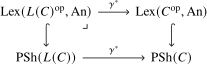 In particular the upper horizontal arrow above is a full embedding whose essential image consists
of those left exact presheaves on \(C\) sending maps in \(W\) to isomorphisms in \(\An\).
Under the equivalence \(\Lex(C\catop,\An)\simeq D\), those correspond to \(T\)-local objects
where
\[
T=\Map([1],W)\hookrightarrow\Map([1],C)\hookrightarrow\Map([1],D)\, .
\]
Since \(S\hookrightarrow T\), it is clear that any \(T\)-local object is \(S\)-local.
Conversely, any \(S\)-local object \(y\) is \(T\)-local: indeed, for any map \(u\colon a\to b\) in \(W\),
since \(\loc_S(u)\) is an isomorphism by definition of \(W\), the map
\[
u^*\colon \Hom_D(b,y)\to\Hom_D(a,y)
\]
is isomorphic to the isomorphism
\[
u^*\colon\Hom_D(\loc_S(b),y)\xrightarrow{\simeq}\Hom_D(\loc_S(a),y)\, .
\]
We obtain a commutative square of the form
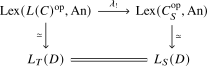 thus proving that the upper horizontal map is an equivalence.
In other words, the adjunction provided by Theorem 18.2.8
\[
\lambda_!\colon\Lex(L(C)\catop,\An)\rightleftarrows\Lex(C_S\catop,\An)\colon\lambda^*
\]
consists of equivalences. Since the restriction of \(\lambda_!\) to representable presheaves
is isomorphic to the composition of \(\lambda\) with the Yoneda embedding of \(C_S\), this proves that
the functor \(\lambda\) is fully faithful. Since
\[
\lambda^\simeq\colon L(C)^\simeq\to C_S^\simeq
\]
is a cover by construction, this proves that \(\lambda\) is an equivalence.
From Section 18.4, Left Bousfield localization of compactly generated categories.