Construction 15.2.1 (The spine of a simplex). The spine \(\segal{n}\) is the simplicial anima obtained by gluing
\(n\) copies of \(\Delta^1\) end to end. More precisely, set
\(\segal{0}=\Delta^0\), with its unique vertex as last vertex, and define
\(\segal{n+1}\) by the pushout square
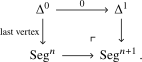 The last vertex of \(\segal{n+1}\) is the image of the vertex \(1\) of the
new edge. All pushouts are taken in \(\PSh(\simp)\).
There is a canonical map \(i_n\colon\segal{n}\to\Delta^n\), sending each edge to the corresponding consecutive edge of \(\Delta^n\). Inductively, \(i_0\) is the identity, and \(i_{n+1}\) is induced by the composite \(\segal{n}\to\Delta^n\to\Delta^{n+1}\) and the last edge \(\Delta^1\to\Delta^{n+1}\). The latter is induced by \[ [1]=[0]\star[0]\longrightarrow[n]\star[0]=[n+1], \] using the last vertex of \([n]\) on the first factor and the identity on the second. The two maps agree on the gluing vertex, and \(i_{n+1}\) preserves the last vertex.