Proposition 4.3.11. Let \(C\) be a category. Then the commutative diagram
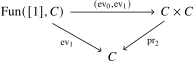 determines a right fibration relative to \(C\). Dually, the diagram
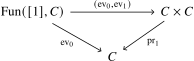 determines a left fibration relative to \(C\).
Proof
We prove the first statement. Put \(E=\Fun([1],C)\), \(D=C\times C\), and \(f=(\ev_0,\ev_1)\), with structural maps \(\ev_1\) and \(\pr_2\). The source of relative directed evaluation is \[ \ulFun_C([1]_C,E) =C\times_{\Fun([1],C)}\Fun([1],\Fun([1],C)), \] where the map from the square category is restriction to the target side. By Corollary 2.2.8, the defining pullback identifies this category with \(\Triang(C)\) over \(C\), with structural functor \(\ev_2\). The comparison replaces a triangle by the square whose target side is the identity of its last vertex. It includes the identification of that side with the constant arrow, as part of the pullback cone.
We next identify the target \(D\vectimes{f,C}E\). Using preservation of products by \(\Fun([1],-)\) in its defining pullbacks gives \[ D\vectimes{f,C}E\simeq C\times_{\Fun([1],C)} \bigl((\Fun([1],C)\times\Fun([1],C))\times_{C\times C}\Fun([1],C)\bigr). \] In the inner pullback the two functors are \((\ev_1,\ev_1)\) and \((\ev_0,\ev_1)\). The outer pullback uses the second arrow in the product and the identity-arrow functor from \(C\). A diagram in this category therefore consists of an arrow \(v\colon b\to c\) of \(C\), an arrow \[ (u,w)\colon(a,c')\longrightarrow(b,c) \] in \(C\times C\), and the identification of \(w\) with an identity supplied by the pullback over \(\Fun([1],C)\). Preservation of products by \(\Fun([1],-)\) separates the two coordinates. Pasting the pullback that identifies the second coordinate with an identity leaves the pullback \[ \Fun([1],C)\times_{\ev_1,C,\ev_0}\Fun([1],C). \] Its two projections record \(u\colon a\to b\) and \(v\colon b\to c\), with the identification of their common vertex. The structural functor to \(C\) is the target of \(v\). In particular, this calculation retains both the matching of the two arrows and the identification of the second-coordinate arrow with an identity.
Under these two pullback comparisons, relative directed evaluation becomes the short-edge restriction \[ \Triang(C)\longrightarrow \Fun([1],C)\times_{\ev_1,C,\ev_0}\Fun([1],C). \] Indeed, its projection to \(E\) records the target arrow \(v\), and the first coordinate of its other projection records \(u\). The remaining coordinate and its identification are the identity side of the square defining the triangle comparison. Thus the identification of functors is an identification of the complete pullback cones, and is over \(C\) via the last vertex. The Segal axiom makes this restriction an equivalence. Its inverse acquires its structural identification over \(C\) from the inverse identification of this equivalence, so it is an equivalence over \(C\). This proves the right-fibration assertion.
For the second assertion use the source side of the square and the first pullback in Corollary 2.2.8. Relative directed evaluation at the source is identified with the same short-edge restriction, now over \(C\) via the first vertex. The Segal axiom again gives an equivalence over \(C\).