Proposition 4.6.1. The map \(j_0\) is a left adjoint section of the map \(p_0\). The map \(j_1\) is a right adjoint section of the map \(p_2\).
Proof
We prove the claim for \(j_1\) and \(p_2\) and leave the analogous case for \(j_0\) and \(p_0\) to the reader. For simplicity we write \(j := j_1\) and \(p := p_2\) for the remainder of this proof. By construction \(j\) is a section of \(p\). We will construct a natural transformation \(\eta\colon \id_{[1] \times [1]} \to jp\), or equivalently a map \[ h\colon ([1] \times [1]) \times [1] \to ([1] \times [1]) \] such that \(h(x,y,0) = (x,y)\) and \(h(x,y,1) = jp(x,y) = (\max(x,y),y)\), where the last equality holds by Lemma 2.1.26. Formally, we may define \(h\) by \[ h(x,y,t) = (\max(\min(t,y),x),y), \] using the maps \(\max\) and \(\min\) from Construction 2.1.11. Indeed, when \(t = 0\), we have \(\min(t,y) = \min(0,y) = 0\), so that the first component is \(\max(0,x) = x\). When \(t = 1\), we have \(\min(t,y) = \min(1,y) = y\), so that the first component is \(\max(y,x)=\max(x,y)\).
Pictorially, we may display \(h\) as the following commutative cube in \([1] \times [1]\) (read from front to back):
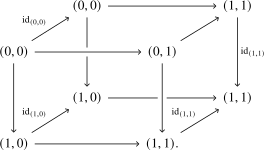 An explicit computation using the relations from Lemma 2.1.12 shows that the composite \(ph\) is the identity transformation \(\id_{p}\colon p \to p\). Similarly, one can show that the composite \(h (j \times 1)\) is the identity transformation \(\id_j\colon j \to j\). This finishes the proof.