Lemma 14.6.4. Let \(\Oo \) be an \(\infty \)-operad and let \(q\colon C^{\otimes } \to \Oo ^{\otimes }\) be a cocartesian fibration. Then the composite \[ C^{\otimes } \xrightarrow {q} \Oo ^{\otimes } \xrightarrow {p_{\Oo }} \Span (\Fin ) \] exhibits \(C^{\otimes }\) as an \(\infty \)-operad if and only if the functor \(\Str ^{\cc }(q)\colon \Oo ^{\otimes } \to \Cat _{\infty }\) preserves finite products. In this case, the morphism \(q\colon C^{\otimes } \to \Oo ^{\otimes }\) is automatically a morphism of \(\infty \)-operads.
Proof. Write \(F:=\Str ^{\cc }(q)\). Condition (i) of Proposition 14.1.12 holds for \(p_{\Oo }q\): first lift a backwards span along \(p_{\Oo }\) and then lift the resulting morphism along \(q\). Pasting the cocartesian universal properties shows that this gives a \((p_{\Oo }q)\)-cocartesian lift.
For every finite set \(I\), transport along the inert projections gives a square
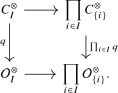
The bottom functor is an equivalence, so condition (ii) holds precisely when this square is a pullback. Checking on fibers reduces this to requiring that \(F(o)\to \prod _{i\in I}F(o_i)\) be an equivalence for every tuple \(o=\{o_i\}_{i\in I}\). Since products in \(\Oo ^{\otimes }\) concatenate tuples, this is equivalent to \(F\) preserving finite products.
Assume these conditions hold, and let \(X\to X_i\) be the \(q\)-cocartesian lifts of the projections \(\rho _i\colon o\to o_i\). For any \(Y\) over \(o'\), the canonical map \(\Hom _{C^{\otimes }}(Y,X)\to \prod _i\Hom _{C^{\otimes }}(Y,X_i)\) lies over the isomorphism \(\Hom _{\Oo ^{\otimes }}(o',o)\iso \prod _i\Hom _{\Oo ^{\otimes }}(o',o_i)\). Its fiber at \(\beta \colon o'\to o\) identifies with \[ \Hom _{F(o)}(\beta _!Y,X)\longrightarrow \prod _i\Hom _{F(o_i)}((\rho _i\beta )_!Y,X_i), \] which is an isomorphism because \(F(o)\simeq \prod _iF(o_i)\). Thus \(X\simeq \prod _iX_i\), proving condition (iii). These products, and hence all finite products obtained by concatenating tuples, are preserved by \(q\). Therefore \(q\) is a morphism of \(\infty \)-operads. □