Proposition 6.1.6. Assume that \([1]\) detects equivalences. Then universals are functorial.
Proof
By Lemma 6.1.3 the objectwise section \(x\mapsto s_x\) has unique arrow lifts; hence by Lemma 6.1.1 there is a section \(s\colon C\to D\) extending it (including the implicit identification \(\epsilon\colon ps=\id_C\)). It remains to show that the section \(s\) is indeed right adjoint (or left adjoint). Let us treat the cocartesian/right adjoint case.
Consider the following pullback
 where the right vertical map is obtained by taking horizontal pullbacks
in the diagram
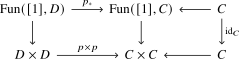 Explicitly, the terms of \(E\) are tuples
\((d : D, \eta \colon d\to sp d, p\eta = \epsilon^{-1} p)\)
and \(q\colon E\to D\) is the projection onto the first component.
We claim that \(\Map([1],q)\) is an equivalence of animae.
For this, we must show that given an arrow \(\delta\colon d\to d'\) in \(D\),
there is a unique commutative square
 This follows by applying
Lemma 6.1.3
three times:
twice to find the unique lifts \(\eta\) and \(\eta'\),
and once more to find the unique identification
\(sp\delta \circ \eta = \eta' \circ \delta\)
filling the commutative square
(both sides live in the contractible anima of lifts
\(d\to spd'\) over the given arrow \(pd \to pspd'\)).
Since \([1]\) detects equivalences, we conclude that \(q\) is an equivalence. We claim that the resulting functor \begin{equation} \eta\colon D\simeq E \to \Fun([1],D)\times_{\Fun([1],C)}C \tag{6.7}\end{equation} exhibits \(s\) as a right adjoint section of \(p\). By construction, \(\eta\) is a transformation over \(C\). By the dual of Proposition 4.4.12, it remains to show that the restricted transformation \begin{equation} C \times [1] \xrightarrow{s\times [1]} D \times [1] \xrightarrow{\eta} D \tag{6.8}\end{equation} is a natural isomorphism. By Proposition 3.4.6, we may check this objectwise. For each object \(x\in C\), naturality of \(\epsilon\) gives \(ps(\epsilon_x)=\epsilon_{psx}\). Hence the isomorphism \(s(\epsilon_x^{-1})\colon s_x\to s_{psx}\) and \(\eta_{s_x}\) lie over the same base arrow. By uniqueness of lifts into the selected terminal object, they are identified. Thus \(\eta_{s_x}\) is invertible, as required.