Construction 15.1.1 (Evaluation at the last vertex). Let \(A\) be a small category and \(i\colon A\to\Cat\) a functor. For each
object \(a\) of \(A\), choose a terminal object \(e_a\) of \(i(a)\). For a small
category \(C\), define its category of \(A\)-simplices by the pullback
 Thus an object of \(A_{/C}\) is a functor \(\gamma\colon i(a)\to C\), and
\(A_{/C}\to A\) is the right fibration classified by
\(a\mapsto\Hom_{\Cat}(i(a),C)\). We will construct a functor
\[
\tau_C\colon A_{/C}\to C,\qquad
(a,\gamma)\longmapsto\gamma(e_a).
\]
Recall from Proposition 12.6.7 that the inclusion \(\RFib(C)\hookrightarrow\Cat_{/C}\) has a left adjoint \(L\). The composite \[ A_{/C}\xrightarrow{i_{/C}}\Cat_{/C}\xrightarrow{L}\RFib(C) \] sends \(\gamma\colon i(a)\to C\) to the representable right fibration \(C_{/\gamma(e_a)}\to C\). Indeed, factor \(\gamma\) as a terminal functor \(u\colon i(a)\to X\) followed by a right fibration \(X\to C\). The object \(u(e_a)\) is terminal in \(X\), so it identifies \(X\) with \(C_{/\gamma(e_a)}\) over \(C\). The Yoneda embedding identifies the full subcategory of representable right fibrations with \(C\), giving the desired functor \(\tau_C\).
On a morphism represented by a commutative triangle
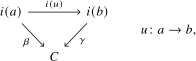 it gives the morphism
\(\beta(e_a)\simeq\gamma(i(u)(e_a))\to\gamma(e_b)\) induced by
terminality of \(e_b\).
The compatibility of \(L\) with composition over the base,
Remark 12.6.8, makes this construction
natural in \(C\). For every \(f\colon C\to D\), we have a commutative square
 where \(f_!\) is composition with \(f\).