Theorem 20.7.8. Let \(C\) be any admissible class of Waldhausen categories. Then the full embedding \[ \FunProd(\WaldCat_C,\An_{\bullet}) \hookrightarrow \Add(\WaldCat_C,\An_{\bullet}) \] has a left adjoint defined explicitly by assigning to each finite-product-preserving functor \[ F\colon\WaldCat_C\to\An_{\bullet} \] the functor defined by the rule \[ A\mapsto \Omega\Big( \underset{[m] : \Delta\catop}{\colim}\, \underset{[n] : \Delta\catop}{\colim}\, F(w_m\Scons_n(A)) \Big) \]
Proof
Given a finite products functor \(F\colon\WaldCat_C\to \An_{\bullet}\), we define, for \(A : \WaldCat_C\), \[ PF(A):=\underset{[m] : \Delta\catop}{\colim}\, \underset{[n] : \Delta\catop}{\colim}\, F(w_m\Scons_n(A))\, . \] We will establish first that \(PF\) is additive. For this, we observe that the formation of \(PF\) commutes with the operation of restriction to \(\WaldCat_{C'}\) for any embedding \(C'\hookrightarrow C\), with \(C'\) an admissible class of Waldhausen categories. Furthermore, a finite-product-preserving functor from \(\WaldCat_C\) to \(\An_{\bullet}\) is additive if and only if its restriction to \(\WaldCat_{C'}\) for any small \(C'\) is additive. Therefore, in order to prove that \(PF\) is additive, without any loss of generality, we may assume that \(C\) is small. Since \(F\) commutes with finite products, \(F\) is then a small sifted colimit of corepresentable functors by Lemma 20.1.5. By virtue of the last assertion of Proposition 20.1.2, we see that the functor \(F\mapsto PF\) commutes with sifted colimits (as a small sifted colimit of functors that preserves sifted colimits). Therefore, we deduce from Proposition 20.4.8 that it suffices to prove that \(PF\) is additive whenever \(F\) is corepresentable by a Waldhausen category \(B\) in the class \(C\). But then, we observe that \[ w_m\Scons_n\WaldCat(B,A)^\simeq=\WaldCat(B,w_m\Scons_n(A))^\simeq\, . \] for all \(m,n\) and \(A\) functorially. In other words we then have \[ PF(A)=\underset{[m] : \Delta\catop}{\colim}\, \underset{[n] : \Delta\catop}{\colim}\, w_m\Scons_n\WaldCat(B,A)^\simeq\, . \] Using the fact that \[ \WaldCat(B,\ExactSeq(A))=\ExactSeq(\WaldCat(B,A)) \] \[\quadtext{and} w([1],\Wald(B,A))=\Wald(B,w([1],A)) \, , \] we conclude from Lemma 20.6.4 that \(PF\) is additive.
To prove the second part, we also reduce to the case where \(C\) is small: we choose a larger universe \(\Cat'\) containing \(\Cat\) so that \(C\) is small. If \(\An'\) is the full subcategory of animae in \(\Cat'\), we know that the embedding \[ \An\hookrightarrow\An' \] commutes with small colimits and with small limits. This means that the induced full embedding \[ \FunProd(\WaldCat_C,\An_{\bullet})\hookrightarrow \FunProd(\WaldCat_C,\An'_{\bullet}) \] also commutes with small limits and with small colimits. In particular, it commutes with the loop functor \(\Omega\) as well as with the operator \(P\) defined above. This means that it suffices to prove the universal property of the construction \(\Omega\, P\) in the larger universe \(\Cat'\) for which \(C\) is small.
From now on, we focus on the case where \(C\) is small and we keep track of the notations of Definition 20.7.6.
Now, Proposition 20.4.13 tells us that the operator \(P\) comes equipped with
a natural map of the form
\[
c_F\colon F\to \Omega(PF)
\]
that is invertible whenever \(F\) is additive. Furthermore,
since the category \(\Delta\catop\) is small and sifted, Lemma 20.7.7
tells us that the operator \(P\) preserves additive equivalences. Let \(G=i\alpha(F)\)
be the universal additive functor associated to \(F\). The unit map \(\eta\colon F\to G\)
is then an additive equivalence with additive codomain.
We obtain a commutative square
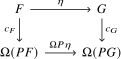 with \(P\eta\) an additive equivalence between additive functors, hence an equivalence.
Since \(c_G\) is an equivalence, this proves that \(c_F\) is an additive equivalence with additive codomain,
which implies the theorem right away.
From Section 20.7, The universal property of Waldhausen construction.