Proposition 4.4.17. Left (respectively right) adjoint sections are stable under pushout.
Proof
We prove the claim for right adjoint sections; the other claim is dual.
Consider a pushout square
 where \((s,\epsilon\colon \id_C\to sf)\)
is a right adjoint section of \(f\colon C\to D\).
By the universal property of the pushout
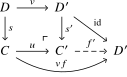 we obtain a map \(f'\) with \(f's'=\id_{D'}\).
Similarly, we define the map \(\epsilon'\colon C'\times [1]\to C'\) over \(D'\)
via the following commutative diagram (over \(D'\))
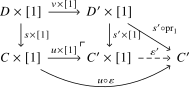 using that \(-\times [1]\) preserves pushouts.
At \(0,1\in [1]\) this diagram restricts to
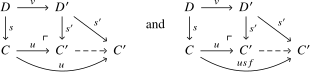 respectively,
which have (unique) solutions \(\id_{C'}\) and \(s'f'\)
(using the given identifications \(s'f'u=s'vf=usf\));
this shows that \(\epsilon'\) is indeed a transformation
\(\id_{C'}\to s'f'\) over \(D'\).
Finally, \(\epsilon'\circ (s'\times [1])=s'\circ \pr_1\) by construction.
Thus \((s',\epsilon')\) is a right adjoint section of \(f'\).
From Section 4.4, Adjunctions.