Lemma 2.2.6 (Unitality). For every morphism \(f\colon x\to y\), there are identifications \[ \id_y\circ f= f= f\circ\id_x \] in \(C(x,y)\), with its given endpoint identifications. They are natural in \(f\): they define identifications of functors \(\Ar(C)\to\Ar(C)\) over \(C\times C\).
Proof
We use the degenerate triangle
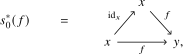 obtained by restricting \(f\) along \(s_0\). Its short edges are
\((\id_x,f)\) and its long edge is \(f\). These identifications respect
the three vertices: after uncurrying, their compatibility is given by
the vertex identifications of Lemma 2.1.16.
The chosen triangle \(j_C(\id_x,f)\) has the same short edges, with comparison given by \(\varepsilon_C\). The Segal equivalence therefore identifies these two triangles, with this comparison on their short edges. Restriction to the long edge gives an identification \[ f\circ\id_x=d_1^*j_C(\id_x,f) = d_1^*s_0^*(f) = f. \] This identification also respects the prescribed source and target: the interchange law allows us to compare endpoints before or after comparing the triangles. The short-edge identifications of the degenerate triangle then cancel with their inverses, leaving the vertex comparisons followed by the components of \(\varepsilon_C\). These are exactly the source and target identifications used to define composition.
The same argument with \(s_1\) gives \(\id_y\circ f=f\).
For naturality in \(f\), we apply both constructions to the universal arrow on \(\Ar(C)\), working with term expressions in context \(\Ar(C)\). (In terms of actual functors, this translates to restriction and lifting through the Segal equivalence.) This results in the required identifications of functors over \(C\times C\).