Lemma 15.1.5 (Décalage on categories of simplices). Let \((A,i)\) be equipped with a décalage structure, and let \(C\) be a small category with terminal object \(t\). Write \(p\colon A_{/C}\to A\) for the projection and \(A^t_{/C}\) for the fiber of \(\tau_C\) at \(t\). Then \((A_{/C},i\circ p)\) inherits a décalage structure with distinguished object \((\omega,t)\). Its endofunctor \(D_C\) takes values in \(A^t_{/C}\), and the structure restricts to this full subcategory.
Proof
We construct \(D_C\) by extending each simplex \(\gamma\colon i(a)\to C\)
across \(i(d_a)\) and sending the appended vertex to \(t\).
Write \(p\colon A_{/C}\to A\) for the projection and form the pullbacks
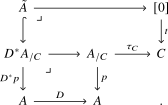 An object of \(\tilde A\) is a pair \((a,\gamma)\) with
\(\gamma\colon i(D(a))\to C\) preserving terminal objects. By naturality
of \(b\) and condition (iv) of Definition 15.1.3, every \(i(D(u))\)
preserves the appended terminal vertex. Thus this full subcategory of
\(D^*A_{/C}\) is stable under right-fibration transport, and its projection
to \(A\) is a right fibration.
Restriction along \(i(d_a)\) gives a morphism of right fibrations \[ \varphi\colon\tilde A\to A_{/C} \] over \(A\). Its fiber over \(\gamma\colon i(a)\to C\) is the anima of extensions \(i(a)\star[0]\to C\) with cone value \(t\). Such extensions are lifts of \(\gamma\) to \(C_{/t}\). Since \(C_{/t}\to C\) is an equivalence, the fiber is contractible. Hence \(\varphi\) is an equivalence.
Choose an inverse to \(\varphi\) over \(A\) and define \(D_C\) by the composite \[ A_{/C}\xrightarrow{\varphi^{-1}}\tilde A \hookrightarrow D^*A_{/C}\longrightarrow A_{/C}. \] The maps \(d_a\) and \(b_a\) give natural transformations \[ \id_{A_{/C}}\xrightarrow{d_C}D_C\xleftarrow{b_C}\omega_C, \] where \(\omega_C\) is the constant functor at the simplex \(i(\omega)\simeq[0]\xrightarrow{t}C\). The first transformation is induced by restriction along \(i(d_a)\); the second uses the identification of the appended vertex with \(t\).
By construction, \(pD_C\simeq Dp\), and \(d_C\) and \(b_C\) project to \(d\) and \(b\). We therefore have equivalences \[ i(p(D_C(\xi)))\simeq i(D(p(\xi)))\simeq i(p(\xi))\star[0], \] natural in \(\xi:A_{/C}\). Their compatibility with \(d_C\) and \(b_C\) is inherited from the compatibility diagram for the original décalage structure. Together with the terminal objects \(e_a\) of \(i(a)\) and the distinguished simplex \((\omega,t)\), these data give the required décalage structure on \((A_{/C},i\circ p)\).
Every appended vertex has value \(t\), so \(D_C\) takes values in \(A^t_{/C}\), and \((\omega,t)\) also belongs to this full subcategory. All the data consequently restrict to a décalage structure there.