Definition 15.1.3. Let \(A\) be a small category and \(i\colon A\to\Cat\) be a functor. A décalage structure on the pair \((A,i)\) consists of the following data.
(i) For each object \(a\) of \(A\), there is a terminal object \(e_a\) in \(i(a)\).
(ii) There is an object \(\omega\) of \(A\) satisfying \(i(\omega)\simeq[0]\).
(iii) There is an endofunctor \(D\colon A\to A\) equipped with a natural equivalence \[ i\circ D\iso i(-)\star[0]. \]
(iv) There are natural transformations \[ d\colon\id_A\to D\qquad\text{and}\qquad b\colon\omega_A\to D \] (where \(\omega_A\) is the constant \(A\)-indexed functor with value \(\omega\)) and a commutative diagram in \(\Fun(A,\Cat)\), whose value at \(a\) is
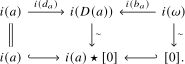 Here the vertical arrows use the equivalences in (ii) and (iii),
and the horizontal maps of the bottom line are the structural embeddings.