Remark 5.3.16 (Diagrams over a base). The pullback description of diagrams in a family also makes sense over an arbitrary base category. Let \(p\colon X\to\Gamma\) be a functor and let \(K\) be an absolute category. The category \[ \Gamma\times_{\Fun(K,\Gamma)}\Fun(K,X) \] describes \(K\)-shaped diagrams in \(X\) equipped with an identification of their image in \(\Gamma\) with a constant diagram. Here \(\Gamma\to\Fun(K,\Gamma)\) assigns constant diagrams. Thus these are diagrams lying over a single object of \(\Gamma\).
For example, the category of isomorphisms in \(X\) equipped with an identification of their image with an identity in \(\Gamma\) is
\[
\Gamma\times_{\Iso(\Gamma)}\Iso(X).
\]
The identity-isomorphism functor induces an equivalence from \(X\) to this category over \(\Gamma\). Indeed, the naturality square
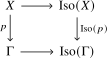 has equivalences as its horizontal functors by Axiom F, and is therefore a pullback. This illustrates how an equivalence of diagram categories that respects constant diagrams gives an equivalence for diagrams over a fixed object of the base.