Definition 6.1.4 (Functoriality of universals). The functoriality of universals principle is the following assertion. Let \(p\colon E\to C\) be a cocartesian (resp. cartesian) fibration. Suppose that for every object \(x\) of \(C\) we are given a terminal (resp. initial) object \(s_x\) of the fiber \(E_x\). Then this family extends to a right (resp. left) adjoint section \(s\) of \(p\).
More explicitly, the family \(s_x\) is a terminal (resp. initial) object of \(E_x\) in context \(x:C^{\simeq}\). The total category of this contextual category is the pullback
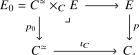 By Proposition 5.3.11, the given family corresponds to a right (resp. left) adjoint section \(s_0\) of \(p_0\). The extension includes an identification of the restriction of \(s\) with \(s_0\) as sections over \(C^{\simeq}\), including their section identifications.