Corollary 4.4.24. There is an equivalence \(\Hom_{[1]}(1,0) \simeq \emptyset\).
Proof
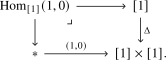
We first show that every morphism \(f\colon 1 \to 0\) in \([1]\) is an isomorphism with inverse the canonical morphism \(\can\colon 0 \to 1\). Indeed, by Corollary 4.4.23 there are unique identifications \(f \circ \can = \id_0\) and \(\can \circ f = \id_1\), so that \(\can\) provides both a left and a right inverse to \(f\). Since \([1] \simeq \Iso([1]) \hookrightarrow \Fun([1],[1])\) is an embedding by Lemma 2.3.3, we deduce that \(\Hom_{[1]}(1,0)\) sits in a pullback square as follows:
 Furthermore, since \([1]^{\simeq} \hookrightarrow [1]\) is an embedding Corollary 2.5.3, the right-hand square in the following commutative diagram is a pullback square, and hence by the pasting law so must be the left-hand square:
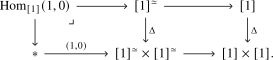 But since \([1]^{\simeq} \simeq \{0,1\}\) is a disjoint union of two points, we see that
\[
[1]^{\simeq} \times [1]^{\simeq} \simeq \{(0,0), (0,1), (1,0), (1,1)\}
\]
is a disjoint union of four points, and the diagonal map corresponds to the inclusion
\[
\{(0,0), (1,1)\} \hookrightarrow \{(0,0), (0,1), (1,0), (1,1)\}\, .
\]
It thus follows from the universality of disjoint unions, Axiom B.5', that the pullback over the point \((1,0)\) is empty.
From Section 4.4, Adjunctions.