Lemma 6.5.6. Let \(f\colon C \to D\) be a functor. Then \(f\) is a left (resp. right) fibration if and only if the square
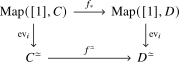 is a pullback for \(i = 0\) (resp. \(i = 1\)).
Proof
By symmetry, it suffices to treat the case of left fibrations. One direction is clear by Lemma 4.2.2, so assume conversely that the square in the statement is a pullback. Write \[ \vec{\ev}^f_0\colon \Fun([1],C) \to C \vectimes{f} D \] for the directed evaluation map. By assumption, its underlying map on groupoid cores \[ (\vec{\ev}^f_0)^{\simeq}\colon \Map([1],C) = \Fun([1],C)^{\simeq} \to C^{\simeq} \times_{D^{\simeq}} \Fun([1],D)^{\simeq} = (C \vectimes{f} D)^{\simeq} \] is an equivalence, and in particular \(\vec{\ev}^f_0\) is strongly surjective. By Theorem 6.3.8, it remains to show that it is fully faithful.
The pullback hypothesis also says that for every object \(a\) of \(C\) and every morphism \(\gamma\colon f(a) \to d\) in \(D\), the anima of lifts of \(\gamma\) with source \(a\) is contractible. Consider objects \(u\colon x_0 \to x_1\) and \(v\colon y_0 \to y_1\) of \(\Fun([1],C)\). We show that the induced map
\[
\Hom_{\Fun([1],C)}(u,v) \to \Hom_{C \vectimes{f} D}((x_0,f(u)), (y_0,f(v)))
\]
is an equivalence by showing that each of its fibers is contractible. Fix a morphism in the target. It consists of a morphism \(\alpha\colon x_0 \to y_0\) in \(C\), a morphism \(\beta\colon f(x_1) \to f(y_1)\) in \(D\), and a commutative square
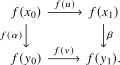 The anima of lifts of \(\beta\) with source \(x_1\) is contractible, so choose a lift \(\beta'\colon x_1 \to z\). The two composites \(\beta'u\) and \(v\alpha\) are lifts with source \(x_0\) of the same morphism \(\beta f(u) = f(v)f(\alpha)\). Contractibility of the corresponding lift anima supplies a unique isomorphism \(i\colon z \iso y_1\) over \(\id_{f(y_1)}\) such that \(i\beta'u = v\alpha\). The composite \(\overline{\beta}=i\beta'\) therefore defines a lift of the chosen target morphism to a morphism \(u\to v\) in \(\Fun([1],C)\). Both choices were made in contractible animae, so the anima of such lifts is contractible. Thus \(\vec{\ev}^f_0\) is fully faithful and hence an equivalence.
From Section 6.5, Pointwise and fiberwise criteria for fibrations.