Lemma 15.5.3 (Hebestreit and Steinebrunner [HS25]). Under the assumptions of Construction 15.5.2, the functor \(q\colon W(d)_{c/}\to W_{[n]/}\) is a right fibration with fiber at \(i_n\) canonically isomorphic to \(P_X(x,y)\). Furthermore, the embedding of \(P_X(x,y)\) into \(W(d)_{c/}\) as fiber of \(q\) is an initial functor, inducing a canonical equivalence \[ P_X(x,y)\iso\Pi_{\infty}(W(d)_{c/})\, . \] If furthermore \(X\) is a Segal anima, then the presheaf \[ c\mapsto \Pi_{\infty}(W(d)_{c/}) \] sends all morphisms in \(W_X\) to isomorphisms, so that \[ p_d\colon W(d)\to (\simp_{/X})_{d/} \] is a left calculus of fractions at \(d=([0],y)\) in \(\simp_{/X}\) with respect to \(W_X\).
Proof
Since \(\simp_{/X}\to\simp\) is a right fibration, so is the induced functor \[ (\simp_{/X})_{c/}\to\simp_{[n]/} \] by Proposition 6.5.7. Right fibrations being stable under pullbacks, this yields a right fibration of the form \[ (\simp_{/X})_{c/}\times_\simp W\to\simp_{[n]/}\times_\simp W\, . \] We observe that \([0]\) is an initial object of \(W\) and that \(W_X\to W\) is a right fibration (as pullback of the right fibration \(\simp_{/X}\to\simp\) along the embedding \(W\hookrightarrow\simp\)), hence we get another right fibration through another application of Proposition 6.5.7: \[ W(d)=(W_X)_{d/}\to W_{[0]/}\simeq W\, . \] Therefore, we get by pullback of the latter along the second projection \[ (\simp_{/X})_{c/}\times_\simp W\to W \] a right fibration of the form \[ (\simp_{/X})_{c/}\times_\simp (W_X)_{d/}= ((\simp_{/X})_{c/}\times_\simp W)\times_W (W_X)_{d/}\to (\simp_{/X})_{c/}\times_\simp W\, . \] Composing with the right fibration \((\simp_{/X})_{c/}\times_\simp W\to\simp_{[n]/}\times_\simp W\), this proves that the functor \[ q\colon W(d)_{c/}\to W_{[n]/} \] is a right fibration as composition of two right fibrations.
We observe that \(i_n : (W_{[n]/})^\simeq\) is an initial object. Indeed, an object in \(W_{[n]/}\) is a morphism \(u\colon [n]\to [m]\). A morphism from \(u\colon [n]\to [m]\) to \(u'\colon [n]\to [m']\) is a morphism \(f\colon [m]\to [m']\) such that \(f\circ u=u'\) and \(f(m)=m'\). For \(u\colon [n]\to [m]\), there is a unique map \(\tilde{u}\colon [n+1]\to [m]\) such that \(\tilde{u}(i)=u(i)\) for \(i : [n]^\simeq\) and \(\tilde{u}(n+1)=m\): since objects of \(\simp\) are posets (Example 10.3.5), this follows from the last assertion of Lemma 10.3.7. The morphism \(\tilde{u}\) is the unique morphism from \(i_n\) to the object determined by \(u\). Right fibrations being smooth, since \(i_n\colon *\to W_{[n]/}\) is an initial functor, the embedding of the fiber of \(q\) at \(i_n\) is an initial functor.
Since \(q\) is a right fibration, it is conservative and its fiber at \(i_n\) is an anima. The terms of this anima tautologically consist of those of \(P_X(x,y)\).
It remains to prove the last assertion of the lemma, assuming furthermore that \(X\) is
a Segal anima. In this case, we observe, using Lemma 15.2.3,
that there is a pullback square
of the following form.
 The latter is the outer square in the commutative diagram
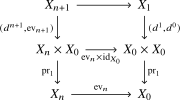 in which the lower square is cartesian.
In other words, we have a pullback square of the form
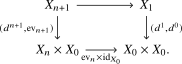 This means that there is a canonical isomorphism of the form
\[
P_X(x,y)\simeq P_X(x_n,y)
\]
where \(x_n : X_0\) is the evaluation of \(x : X_n\) at \(n : [n]^\simeq\).
Let \(c=([n],x)\) and \(c'=([n'],x')\) be two objects of \(\simp_{/X}\).
A morphism \(u\colon c\to c'\) in \(\simp_{/X}\), is a morphism \(u\colon [n]\to [n']\)
in \(\simp\) together with an identification \(s : u^*(x')=x\).
saying that \(u\) belongs to \(W_X\) means that \(u(n)=n'\), which induces through \(s\)
an identification \(\sigma : x_n=x'_{n'}\). Let \(c_0=([0],x_n)\) and \(c'_0=([0],x'_{n'})\).
We have a commutative square in \(\simp_{/X}\) of the form
 inducing a commutative diagram of the following form
 This achieves the proof of the lemma.