Theorem 17.4.9. Let \(\kappa\hookrightarrow\Cat\) be a small subuniverse. Given a small category with \(\kappa\)-small colimits \(C\) and a \(\kappa\)-presentable category \(D\), there is a canonical equivalence of categories of the form \[ \Rex(C,D^\kappa)\simeq\FunL_\kappa(\Ind(C),D)\, . \] In particular, assigning the full subcategory of \(\kappa\)-compact objects defines a fully faithful functor \[ \PrL_\kappa\to\RexCat^\kappa\ , \quad D\mapsto D^\kappa \] that is right adjoint to the functor \[ \Ind_\kappa\colon\RexCat\to\PrL_\kappa\ , \quad C\mapsto\Ind_\kappa(C)\, . \]
Proof
Corollary 17.4.5
and Theorem 17.2.24
ensure that
\[
\Ind_\kappa(D^\kappa)=D\, .
\]
By definition, there is pullback square of the form
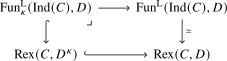 in which, by virtue of Proposition 17.3.8,
the vertical arrow on the right side
is an equivalence. This proves the first assertion of the theorem.
The second one follows from the first by applying the operator \((-)^\simeq\).