Lemma 6.4.19. Let \(f\colon C \to S\) and \(g\colon D \to S\) be functors and assume that \(g\) is conservative. Then the canonical inclusion map \[ \Map_S(C,D) \to \Fun_S(C,D) \] from Definition 1.9.2 is an equivalence.
Proof
The induced functor \(g_*\colon \Fun(C,D) \to \Fun(C,S)\) is conservative. Indeed, if \(g_*\alpha\) is a natural isomorphism, then conservativity of \(g\) implies that every component of \(\alpha\) is invertible. By Proposition 3.4.6, \(\alpha\) is a natural isomorphism. It thus follows from Proposition 6.4.14 that we have a pullback square of the form
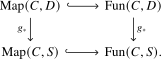 Passing to vertical fibers over \(f\), it follows that the canonical map \(\Map_S(C,D) \to \Fun_S(C,D)\) is an equivalence, as claimed.