Corollary 17.3.12. If the small subuniverse \(\kappa\) is elementary then \(\RexCat_\kappa\) is \(\kappa\)-presentable. Furthermore, the forgetful functor \[ \RexCat_\kappa\hookrightarrow\Cat \] commutes with small \(\kappa\)-filtered colimits.
Proof
The forgetful functor \(\RexCat_\kappa\hookrightarrow\Cat\) is conservative so that
Theorem 17.3.3 implies that
\(\langle [1]\rangle_\kappa\) is a generator of \(\RexCat_\kappa\).
Since \([1]\) is \(\kappa\)-compact in \(\Cat\), it suffices to prove that
the forgetful functor
\[
\RexCat_\kappa\hookrightarrow\Cat
\]
commutes with small \(\kappa\)-filtered colimits.
Let \(I\) be a small \(\kappa\)-filtered category and \(i\mapsto C_i\) an \(I\)-indexed
diagram with values in \(\RexCat_\kappa\). We denote by \(C\) the colimit of this diagram in \(\Cat\).
For any \(\kappa\)-small
category \(A\), we have by Corollary 17.3.10
\[
\underset{i\colon I}{\colim}\, \Fun(A,C_i)=\Fun(A,C)\, .
\]
Therefore, it follows right away from Corollary 17.3.11
that \(C\) has \(\kappa\)-small colimits.
If \(D\) is any small category with \(\kappa\)-small colimits, and if \(f\colon C\to D\)
is a functor such that
\[
f_i\colon C_i\xrightarrow{\mathit{can}_i}C\xrightarrow{f}D
\]
commutes with \(\kappa\)-small colimits for all \(i\colon I^\simeq\),
we then have commutative squares of the form
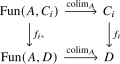 forming an \(I\)-indexed cocone in \(\Fun([1],\Cat)\)
hence yielding a commutative square of the form
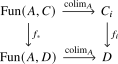 thus proving that \(f\) commutes with \(\kappa\)-small colimits.
From Section 17.3, Presentable categories with respect to a subuniverse.