Proposition 15.1.12. The canonical embedding \(i\colon\simp\hookrightarrow\Cat\) admits a décalage structure.
Proof
The terminal object of \(i([n])=[n]\) is its last vertex \(n\). Let
\(\omega=[0]\), and define
\[
D([n])=[n+1]=[n]\star[0].
\]
For a morphism \(u\colon[m]\to[n]\), set
\(D(u)=u\star\id_{[0]}\). The natural transformation
\(d\colon\id_\simp\to D\) is given by the inclusion of the first summand
\([n]\hookrightarrow[n]\star[0]\), and
\(b\colon\omega_\simp\to D\) is given by the inclusion of the last vertex
\([0]\hookrightarrow[n]\star[0]\). These maps are natural because the join
is functorial. For every \([n]\), the resulting diagram is
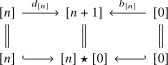 and hence satisfies condition (iv) of Definition 15.1.3.