Construction 15.5.2. Let \(W\) be the subcategory of last vertex maps in \(\simp\) (see the end of Construction 15.1.8).
In other words, \(W\) is the synthetic subcategory of \(\simp\) defined by
\(W^\simeq=\simp^\simeq\) with morphisms those morphisms
\[
f\colon [m]\to [n]
\]
such that \(f(m)=n\). We form the pullback square below.
 Inverting \(W_X\) in \(\simp_{/X}\) yields \(\ac(X)\):
by virtue of Lemma 15.1.10,
there is a canonical equivalence
\[
\simp_{/X}[W^{-1}_X]\iso \ac(X)\, .
\]
We observe that \(W^\simeq_X=(\simp_{/X})^\simeq\).
Given an object \(d\) of \(\simp_{/X}\), we write \(W(d)\) for the co-slice of \(d\),
seen as an object of \(W_X\). There is thus a canonical functor
\[
p_d\colon W(d)\to (\simp_{/X})_{d/}\, .
\]
By construction, this is a putative left calculus of fractions at \(d\).
For \(c : \simp_{/X}\) we write
\[
W(d)_{c/}:=(\simp_{/X})_{c/}\times_{\simp_{/X}} W(d)\, .
\]
The dual version of Proposition 14.3.9 tells us that \(p_d\)
is a left calculus of fractions if and only if the functor
\[
(\simp_{/X})\catop\to\An\ , \quad c\mapsto\Pi_{\infty}(W(d)_{c/})
\]
sends all morphisms in \(W_X\) to isomorphisms.
From now on, we fix a term \(y : X_0\). We interpret the latter as the object \(d=([0],y)\) in \(\simp_{/X}\).
An arbitrary object \(c\) of \(\simp_{/X}\) is a pair of the form \(c=([n],x)\) for some \(n : \N\)
and \(x : X_n\). We define \(P_X(x,y)\) through the pullback square
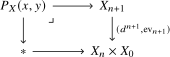 where \(d^{n+1}\) is the operator induced by the canonical embedding \([n]\hookrightarrow[n]\star[0]=[n+1]\)
and \(\ev_{n+1}\) the operator induced by the canonical embedding \([0]\hookrightarrow[n]\star[0]=[n+1]\).
The projection \(\simp_{/X}\to\simp\) induces a functor \[ (\simp_{/X})_{c/}\to\simp_{[n]/} \] inducing with the projection \(W_X\to W\) a canonical functor \[ q\colon W(d)_{c/}\to W_{[n]/}=\simp_{[n]/}\times_\simp W\, . \] Let \(i_n\) be the object of \(W_{[n]/}\) corresponding to the diagram \[ [n]\hookrightarrow[n]\star[0]\, . \]