Proposition 20.8.2 (Waldhausen). Let \(C\) be an admissible class of Waldhausen
categories.
We consider a morphism \(f\colon A\to B\) in \(\WaldCat_C\).
For any additive functor \(E\colon\WaldCat_C\to \An_{\bullet}\), there is a canonical
pullback square of the form below.
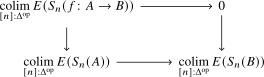 In particular, there is a canonical fiber sequence of the form below.
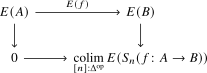
Proof
The last assertion follows from the first by
Proposition 20.4.13. The proof of this proposition is in fact a variation on the proof
of the latter.
Since
\[
{\underset{[n] : \Delta\catop}{\colim}\, }E(\Scons_{n+1}(B))=0\, ,
\]
by Lemma 13.4.4, it suffices to prove that, for each \(n : \N\),
the induced commutative square
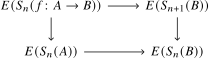 is a pullback square. Through the identifications \(\Scons_n(A)=A^{[n-1]}\) for \(n>0\),
one can identify \(\Scons_n(f\colon A\to B)\) as a category with terms the pairs \((x,y)\)
where \(x\) is a term in \(A^{[n-1]}\) and \(y\) a commutative diagram in \(B\) of the form
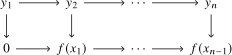 in which all squares are pushout squares.
Let \(v\colon \Scons_n(B)\hookrightarrow\Scons_{n+1}(B)\) be the full embedding
defined by sending a sequence
\[
x_1\to\cdots\to x_n
\]
to the sequence
\[
0\to x_1\to\cdots\to x_n\, .
\]
Since \(u\) is a section of \(i^*_n\), there is a canonical pullback square of the form below
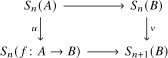 (in particular \(u\) is fully faithful and a section of \(p_n\)).
There is also a full embedding
\[
j\colon B\hookrightarrow\Scons_n(f\colon A\to B)
\]
defined by sending \(x\) to the pair consisting of the sequence of length \(n\)
\[
x\xrightarrow{\id_x}\cdots\xrightarrow{\id_x}x
\]
and of the commutative diagram
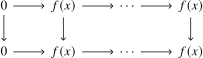 in which all the vertical maps are identities.
The functor \(j\) is a section of the functor \(\pi\) sending a pair \((x,y)\)
to the object \(y_1\). There is an obvious functorial exact sequence of the form
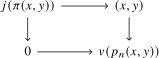 and therefore a direct application of Proposition 20.4.10
shows that the pair of functors
\[
(p_n,\pi)\colon\Scons_n(f\colon A\to B)\to \Scons_n(A)\times B
\]
induces an equivalence
\[
E(\Scons_n(f\colon A\to B))=
E(\Scons_n(A))\times E(B)\, .
\]
It follows that the squares
 are equivalent, hence are both cartesian, which achieves this proof.