Fix a universe \(\Cat\) and a small category \(C\) equipped with a subcategory \[ W\hookrightarrow C\, . \]
We denote by \(\gamma\colon C\to L(C)\) the localization of \(C\) at \(W\). Our aim is to recognize systems of denominators for which there is a canonical isomorphism \[ \underset{w : W(x)\catop}{\colim}\Hom_C(z_w\catop,y) \iso \Hom_{L(C)}(\gamma(x),\gamma(y)). \] A term on the left is represented by a span \[ x\xleftarrow{s_w}z_w\xrightarrow{f}y \] in which \(s_w\) becomes invertible in \(L(C)\); it therefore determines the morphism \(\gamma(f)\circ\gamma(s_w)^{-1}\) from \(\gamma(x)\) to \(\gamma(y)\).
Rather than impose a particular list of Ore conditions, we begin with a weakly contractible category \(W(x)\) of denominators equipped with a distinguished identity denominator. We call such data putative, and then recognize when the resulting candidate Hom-functor descends through the localization. This separates the formal fraction formula from any particular method for constructing the denominator categories.
Definition 14.3.1 (Putative right calculus of fractions). A putative right calculus of fractions at an object \(x : C^\simeq\) is a functor of the form \[ p\colon W(x)\to C_{/x} \] with the following properties:
(i) For any object \(w : W(x)^\simeq\), if we denote by \(s_w\colon z_w\to x\) the morphism corresponding to \(p(w)\), so that \[ p(w)=(z_w,s_w)\, , \] the morphism \(s_w\) is sent to an isomorphism in \(L(C)\).
(ii) There is an object \(i_x : W(x)^\simeq\) equipped with an identification \(p(i_x)=(x,\id_x)\).
(iii) The category \(W(x)\) is weakly contractible.
Dually, a putative left calculus of fractions at \(x : C^\simeq\) is a functor of the form \(p\colon W(x)\to C_{x/}\) such that the induced functor \[ p\catop\colon W(x)\catop\to (C_{x/})\catop=(C\catop)_{/x} \] is a putative right calculus of fractions at \(x : (C\catop)^\simeq\).
Notation 14.3.2 (Hom in the localization). If \(x : C\catop\) and \(y : C\), we define \[ \Hom_{L(C)}(x,y):=\Hom_{L(C)}(\gamma\catop(x),\gamma(y))\, . \]
Construction 14.3.3 (Canonical fraction map). There is a map \[ u\colon\Hom_C(x,y)\to \underset{w : W(x)\catop}{\colim}\Hom_C(z_w\catop,y) \] functorial in \(y\), induced by \(i_x : W(x)^\simeq\) and the identification \(p(i_x)=(x,\id_x)\). Similarly, there is a map of the form \[ v\colon\Hom_{L(C)}(x,y)\to \underset{w : W(x)\catop}{\colim}\Hom_{L(C)}(z_w\catop,y) \] functorially in \(y : C\). The maps \(\gamma(s_w)\colon\gamma(z_w)\to\gamma(x)\) assemble into a natural transformation and are all isomorphisms. Consequently, for every \(y\) the diagram \[ w\mapsto\Hom_{L(C)}(z_w\catop,y) \] is naturally isomorphic to the constant diagram with value \(\Hom_{L(C)}(x,y)\). Since \(W(x)\catop\) is weakly contractible, condition (iii) of Lemma 13.1.11 says that the constant-diagram functor is fully faithful. Since colimit is its left adjoint, the colimit of this constant diagram is its value. It follows that \(v\) is an isomorphism. Composing the map induced by the localization functor \[ \underset{w : W(x)\catop}{\colim}\Hom_C(z_w\catop,y)\to \underset{w : W(x)\catop}{\colim}\Hom_{L(C)}(z_w\catop,y) \] with the inverse of \(v\) yields a map of the form \[ \underset{w : W(x)\catop}{\colim}\Hom_C(z_w\catop,y)\to \Hom_{L(C)}(x,y) \] that is functorial in \(y\). The latter map will be referred to as the canonical map.
The putative calculus therefore supplies a candidate functor \[ H_x\colon C\to\An,\qquad H_x(y)=\underset{w : W(x)\catop}{\colim}\Hom_C(z_w\catop,y). \] The extra condition in the following definition says precisely that \(H_x\) is local with respect to \(W\), and hence descends to \(L(C)\).
Definition 14.3.4 (Right calculus of fractions). A right calculus of fractions at \(x\) is a putative right calculus of fractions \(p\colon W(x)\to C_{/x}\) such that the functor from \(C\) to \(\An\) defined by the rule \[ y\mapsto \underset{w : W(x)\catop}{\colim}\Hom_C(z_w\catop,y) \] sends every morphism in \(W\) to an isomorphism in \(\An\).
Dually a left calculus of fractions at \(x\) is a putative left calculus of fractions at \(x\) that becomes a right calculus of fractions at \(x\) after applying the operator \((-)\catop\).
Proposition 14.3.5 (Recognition of a calculus of fractions). Let \(p\colon W(x)\to C_{/x}\) be a putative right calculus of fractions at an object \(x\) of \(C\). A necessary and sufficient condition for this putative right calculus of fractions at \(x\) to be a right calculus of fractions at \(x\) is that the canonical map \[ \underset{w : W(x)\catop}{\colim}\Hom_C(z_w\catop,y)\longrightarrow \Hom_{L(C)}(x,y) \] is invertible for all \(y\). Furthermore, when this condition holds, the resulting isomorphism is uniquely characterized by its functoriality in \(y\) and by the property that it sends the identity of \(x\), viewed as a term of the colimit through \(i_x\), to the identity morphism of \(\gamma(x)\) in \(L(C)\).
Proof
We identify the condition that \(H_x\) descend through \(\gamma\) with invertibility of its localization unit. We then compare this unit with the canonical fraction map and finally use the Yoneda lemma to prove the asserted uniqueness.
We have an adjunction of the form \[ \gamma_!\colon\Fun(C,\An)\rightleftarrows\Fun(L(C),\An)\colon\gamma^* \] and the right adjoint \(\gamma^*\) is fully faithful, with essential image those functors from \(C\) to \(\An\) sending every morphism in \(W\) to an isomorphism. The functor \(\gamma_!\) preserves small colimits because it is a left adjoint, while \(\gamma^*\) preserves them because colimits in functor categories are computed pointwise, by Lemma 7.3.1. Hence the unit \[ \eta_F\colon F\to\gamma^*\gamma_!(F) \] is compatible with small colimits in \(F\). Since \(\gamma^*\) is fully faithful, \(\eta_F\) is an isomorphism if and only if \(F\) sends every morphism in \(W\) to an isomorphism. For \(F=\Hom_C(x,-)\), the unit map coincides with the map \[ \eta\colon\Hom_C(x,-)\to\Hom_{L(C)}(\gamma(x),\gamma(-)) \] induced by \(\gamma\). Set \[ H_x:=\underset{w : W(x)\catop}{\colim}\Hom_C(z_w\catop,-). \] Applying the naturality of Yoneda from Proposition 12.3.18 to \(\gamma\catop\), the unit at \(H_x\) identifies with the colimit of the units for the representable functors \(\Hom_C(z_w,-)\): \[ \eta'\colon H_x\longrightarrow \underset{w : W(x)\catop}{\colim}\Hom_{L(C)}(\gamma\catop(z_w\catop),\gamma(-)) \] is an isomorphism if and only if \(H_x\) sends every morphism in \(W\) to an isomorphism. This is precisely the condition that \(p\) be a right calculus of fractions.
For every \(y : C\), consider the commutative diagram
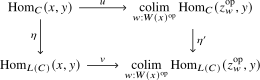 Here the vertical maps are unit maps, while \(u\) and \(v\) are the maps from
Construction 14.3.3. The map \(v\) is an
isomorphism, and the canonical map is \(v^{-1}\eta'\). This proves the first
assertion and also shows that the canonical isomorphism sends the
distinguished identity term to the identity of \(\gamma(x)\) in \(L(C)\).
Finally, when \(p\) is a right calculus of fractions, both \(H_x\) and \(\Hom_{L(C)}(x,\gamma(-))\) descend uniquely to functors on \(L(C)\). Any two isomorphisms with the stated property differ by an automorphism of the representable functor \(\Hom_{L(C)}(x,-)\) that fixes the identity of \(x\). The Yoneda lemma for \(L(C)\catop\) implies that this automorphism is the identity, proving uniqueness.
Example 14.3.6 (The trivial calculus of fractions). Take \(W=C^\simeq\) and \[ W(x)=(C^\simeq)_{/x}, \] with its canonical functor to \(C_{/x}\). The identity of \(x\) is terminal in \(W(x)\), so \(W(x)\) is weakly contractible. Since every denominator is already an isomorphism in \(C\), the functor \(H_x\) is naturally isomorphic to \(\Hom_C(x,-)\) and therefore sends \(W\) to isomorphisms. Thus this is a right calculus of fractions, and its mapping-anima formula reduces to the identity isomorphism for \(\Hom_C(x,y)\).
The mapping-anima formula is the representable case of a pointwise formula for left Kan extension along the localization. Yoneda density extends it from representables to arbitrary presheaves.
Corollary 14.3.7 (Pointwise localization by fractions). Let \(p\colon W(x)\to C_{/x}\) be a right calculus of fractions at an object \(x\). We consider the adjunction on presheaf categories \[ \gamma_!\colon\PSh(C)\rightleftarrows\PSh(L(C))\colon\gamma^* \] induced by the localization functor \(\gamma\colon C\to L(C)\). Then, for any presheaf \(F\colon C\catop\to\An\) there is a canonical isomorphism of the form \[ \underset{w : W(x)\catop}{\colim} F(z_w\catop)\iso \gamma_!(F)(\gamma(x))\, . \]
Proof
We first construct the canonical comparison below. Both its source and target preserve small colimits in \(F\), so Yoneda density reduces its invertibility to the representable case, which is precisely Proposition 14.3.5.
For any presheaf \(G\) on \(L(C)\), the isomorphisms \(\gamma(s_w)\) induce an identification from the constant diagram with value \(G(\gamma(x))\) to the diagram \(w\mapsto G(\gamma\catop(z_w\catop))\). Since \(W(x)\catop\) is weakly contractible, the argument from Construction 14.3.3 shows that taking its colimit gives a natural equivalence \[ G(\gamma(x))\iso \colim_{w : W(x)\catop}G(\gamma\catop(z_w\catop)). \] Take \(G=\gamma_!(F)\). The unit \(F\to\gamma^*G\) also induces a map \[ \underset{w : W(x)\catop}{\colim}F(z_w\catop)\longrightarrow \underset{w : W(x)\catop}{\colim}G(\gamma\catop(z_w\catop)) \, . \] Composing with the inverse of the preceding isomorphism yields a canonical map \[ \underset{w : W(x)\catop}{\colim}F(z_w\catop) \longrightarrow \gamma_!(F)(\gamma(x)). \] Both sides preserve small colimits in \(F\). Therefore, to prove that this map is invertible, Corollary 12.6.4 tells us that it suffices to prove that it is invertible for \(F=\Hom_C(-,y)\) for some object \(y\) of \(C\). In that case, \(\gamma_!(F)\) is \(\Hom_{L(C)}(-,\gamma(y))\) by Proposition 12.3.18. The displayed map is then the canonical fraction map, which is invertible by Proposition 14.3.5.
Remark 14.3.8 (Fractions in the presheaf category). For a right calculus of fractions at \(x\) as in the previous corollary, the Yoneda lemma applied for \(C\) and for \(L(C)\) respectively allows us to write \[ \underset{w : W(x)\catop}{\colim} \Hom_{\PSh(C)}(h_C(z_w),F) \iso \Hom_{\PSh(L(C))}(h_{L(C)}(\gamma(x)),\gamma_!(F)) \] for any presheaf \(F\) on \(C\). Using Proposition 12.3.18, one can recast this formula by saying that any right calculus of fractions at \(x\) of the form \[ p\colon W(x)\to C_{/x} \] induces through the Yoneda embedding of \(C\) a right calculus of fractions at \(h_C(x)\) \[ W(x)\overset{p}{\to}C_{/x}\hookrightarrow\PSh(C)_{/h_C(x)} \] with respect to the localization of \(\PSh(C)\) at the subcategory of morphisms that become invertible under \(\gamma_!\).
The colimit in the fraction formula also has a total-category description. An object of the category below consists of an object \(w\) of \(W(x)\) and a morphism \(f\colon z_w\to y\), hence of a span \[ x\xleftarrow{s_w}z_w\xrightarrow{f}y. \] Informally, its morphisms encode coherent refinements of such spans.
Proposition 14.3.9 (The category of fractions). Let \(p\colon W(x)\to C_{/x}\) be a putative right calculus of fractions at \(x : C^\simeq\). For any other object \(y : C^\simeq\), consider the associated right fibration \[ C_{/y}\to C \] and form the pullback \[ W(x)_{/y}=W(x)\times_CC_{/y}\, . \] There is a canonical isomorphism \[ \Pi_{\infty}(W(x)_{/y})\iso\underset{w : W(x)\catop}{\colim}\Hom_C(z_w\catop,y)\, . \] Moreover, \(p\) is a right calculus of fractions if and only if the functor \[ C\to\An,\qquad y\longmapsto\Pi_{\infty}(W(x)_{/y}) \] sends every morphism in \(W\) to an isomorphism. When these equivalent conditions hold, there is a canonical isomorphism \[ \Pi_{\infty}(W(x)_{/y})\iso \Hom_{L(C)}(x,y)\, . \]
Proof
The right fibration \(W(x)_{/y}\to W(x)\) corresponds to the functor obtained by composing \(\Hom_C(-,y)\) with the functor from \(W(x)\catop\) to \(C\catop\) induced by \(p\catop\). The cocartesian unstraightening of this functor is the left fibration \((W(x)_{/y})\catop\to W(x)\catop\). Therefore Remark 9.3.4 gives \[ \underset{w : W(x)\catop}{\colim}\Hom_C(z_w\catop,y) \iso\Pi_{\infty}((W(x)_{/y})\catop)\, . \] Since there is a canonical equivalence \[ \Pi_{\infty}(W(x)_{/y})\iso \Pi_{\infty}((W(x)_{/y})\catop) \] by Corollary 12.2.6, this proves the assertion. The remaining statements now follow from the definition of a right calculus of fractions and Proposition 14.3.5.
Corollary 14.3.10. Let \(C\) be a small category equipped with a subcategory \(W\hookrightarrow C\), and write \(\gamma\colon C\to L(C)\) for the localization at \(W\). Suppose that \(p\colon W(x)\to C_{/x}\) is a right calculus of fractions at \(x : C^\simeq\). For every object \(y : C^\simeq\), form \[ W(x)_{/y}:=W(x)\times_CC_{/y}. \] Then there is a canonical cover \[ (W(x)_{/y})^\simeq\to\Hom_{L(C)}(x,y) \] sending a pair \((w,f)\), with \(w : W(x)^\simeq\) and \(f\colon z_w\to y\) in \(C\), to the morphism \(\gamma(f)\circ\gamma(s_w)^{-1}\) in \(L(C)\).
Proof
By Corollary 11.2.17, the canonical map \[ (W(x)_{/y})^\simeq\to\Pi_{\infty}(W(x)_{/y}) \] is a cover. Compose it with the canonical isomorphism \[ \Pi_{\infty}(W(x)_{/y})\iso\Hom_{L(C)}(x,y) \] from Proposition 14.3.9. The description on terms follows from the construction of the canonical fraction map.
We have obtained two complementary forms of control over localization. Its universal property shows that suitable finite products descend and that reflective localizations are governed by their local objects. A calculus of fractions then turns the same universal property into explicit formulas for mapping animae and pointwise Kan extensions. Finally, the category \(W(x)_{/y}\) realizes the hom anima as the anima of spans and their refinements. Later chapters use this description both to produce covers of mapping animae and to analyze the category associated to a univalent Segal anima.