Construction 4.1.1 (Directed pullback). Consider two functors \(f\colon A \to C\) and \(g\colon B \to C\). We define the directed pullback \(A \vectimes{f,g} B\) of \(A\) and \(B\) over \(C\) (sometimes called ‘lax pullback’) via the pullback square
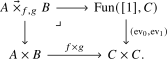 Note that a term of \(A \vectimes{f,g} B\) consists of a triple \((a,b,\phi)\) where \(a\) is a term of \(A\), \(b\) is a term of \(B\), and \(\phi\colon f(a) \to g(b)\) is a morphism in \(C\).
We often abuse notation and write \(A \vectimes{g} B\) in the case where \(C = A\) and \(f = \id_A\colon A \to A\) and dually write \(A \vectimes{f} B\) when \(C = B\) and \(g = \id_B\colon B \to B\).
Given a commutative diagram
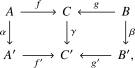 we obtain an induced functor
\begin{align*}
\alpha \vectimes{\gamma} \beta \colon A \vectimes{f,g} B &\to A' \vectimes{f',g'} B', \\
(a,b,\phi) &\mapsto (\alpha(a),\beta(b),\gamma(\phi)),
\end{align*}
where \(\gamma(\phi)\) is the map
\[
f'(\alpha(a)) = \gamma(f(a)) \to \gamma(g(b)) = g'(\beta(b))
\]