Theorem 6.5.17. A (co)cartesian functor between (co)cartesian fibrations is an equivalence if and only if it is an equivalence on fibers. More precisely, consider a commutative triangle
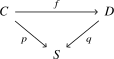 such that \(p\) and \(q\) are cartesian (resp. cocartesian) fibrations and that \(f\) is a cartesian (resp. cocartesian) functor over \(S\). If for every object \(s\) of \(S\) the induced functor \(f_s\colon C_s \to D_s\) is an equivalence, then \(f\) is an equivalence.
Proof
If \(f\) is an equivalence, then every functor \(f_s\) on fibers is an equivalence by base change. Conversely, assume that \(f_s\colon C_s\to D_s\) is an equivalence for every object \(s\) of \(S\). Work in context \(y:D^{\simeq}\) and set \(s=q(y)\). There is a pullback square
 Since \(f_s\) is an equivalence, \(C_y\) is contractible in this context. Its object gives a lift of \(y\) to \(C\), hence, by Corollary 5.3.6, a section of \(D^{\simeq}\times_D C\to D^{\simeq}\). Projecting to \(C\) and factoring through \(C^{\simeq}\) gives the required strong-surjectivity section. Moreover, \(f\) is fully faithful by Lemma 6.5.16. The fundamental theorem of category theory, Theorem 6.3.8, now implies that \(f\) is an equivalence.
From Section 6.5, Pointwise and fiberwise criteria for fibrations.