Theorem 4.3.3. Let \(C\) be a category and let \(x\) be a term of \(C\). Then the forgetful functor \(p_x\colon C_{/x} \to C\) is a right fibration. Dually, the map \(q_x\colon C_{x/} \to C\) is a left fibration.
Proof
By symmetry it will suffice to prove the claim for \(C_{/x} \to C\). We have to show that the functor
\[
\vec{\ev}_1^{p_x}\colon \Fun([1],C_{/x}) \to C \vectimes{p_x} C_{/x}
\]
is an equivalence. By Lemma 4.3.2, the source of this functor sits in a pullback square of the form
 and as a consequence of Corollary 2.2.8 we thus obtain a pullback square
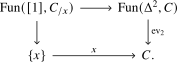 On the other hand, the target \(C \vectimes{p_x} C_{/x}\) is defined via the pullback square
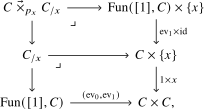 and consequently we obtain a pullback square
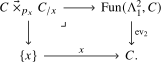 Under these two identifications, the map \(\vec{\ev}_1^{p_x}\colon \Fun([1],C_{/x}) \to C \vectimes{p_x} C_{/x}\) is obtained by pulling back the map \(\Fun(\Delta^2,C) \to \Fun(\Lambda^2_1,C)\) along \(x\colon \{x\} \to C\), and thus it is an equivalence by the Segal axiom Axiom E.