The factorization from the preceding section becomes useful under base change only when its initial or terminal part is preserved. Proper and smooth functors record precisely these two stability properties: proper functors preserve terminal functors under pullback, while smooth functors preserve initial functors under pullback. This will be the input for the two Beck–Chevalley theorems in the final section.
Definition 9.4.1 (Proper/smooth functors, Grothendieck). A functor \(p\colon E \to S\) is called proper (resp. smooth) if for any pullback diagram
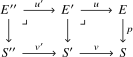 in which \(v'\) is terminal (resp. initial), also \(u'\) is terminal (resp. initial).
Remark 9.4.2 (Slice predicates). The definition belongs to a more general pattern. A predicate on categories determines a corresponding notion of initiality by requiring the relevant relative slices to satisfy that predicate, and hence a corresponding notion of smoothness by requiring stability under base change. For example, a functor \(u\colon C\to D\) is a left adjoint precisely when every relative slice \(C_{/x}\) admits a terminal object. The resulting notion of smoothness is that of a locally cocartesian fibration. In the next section, weak contractibility of the relative slices will instead characterize initial functors.
Remark 9.4.3 (Relation with right Kan extensions). Later we will prove that for a category \(E\) with small limits and any functor
\(u\colon C \to D\) with \(C\) and \(D\) small, the restriction functor
\[
u^*\colon \Fun(D,E) \to \Fun(C,E)
\]
admits a right adjoint \(u_*\colon \Fun(C,E) \to \Fun(D,E)\). Then \(u\) is proper if and only if, for every \(E\) with small limits and every pullback square

the canonical map \(w^*u_* \to u'_*v^*\) is a natural isomorphism of functors \(\Fun(C,E) \to \Fun(D',E)\), and in fact the same property holds for any base change of \(u\).
Lemma 9.4.4. The collection of proper (resp. smooth) functors is closed under composition and base change.
Proof
Closure under base change is immediate from the definition. For composition, let \(p\colon X \to B\) and \(q\colon B \to C\) be proper functors. For functors \(C'' \to C' \to C\) with \(C'' \to C'\) terminal, consider
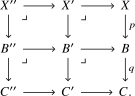 Since \(q\) is proper, also \(B'' \to B'\) is terminal, but then by properness of \(p\) also \(X'' \to X'\) is terminal. This finishes the proof.
Lemma 9.4.5 (Base change of fully faithful right adjoints). Let \(p'\colon X'\to S'\) be a functor such that, for every functor
\(h\colon [1]\times T\to S'\), the base change of the endpoint inclusion
\(\{1\}\times T\hookrightarrow[1]\times T\) along the induced functor
\(X'\times_{S'}([1]\times T)\to[1]\times T\) is terminal. Consider a pullback square
 in which \(v'\) is a fully faithful right adjoint. Then \(u'\) is terminal.
Proof
Let \(w\colon S' \to S''\) be a left adjoint of \(v'\), with counit isomorphism
\(\varepsilon\colon wv' \iso \id_{S''}\) and unit
\(\eta\colon \id_{S'} \to v'w\). Form the pullback
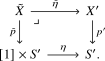 Consider the diagram
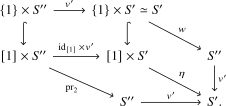 Pulling back this diagram along \(p'\) gives
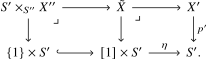
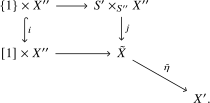 The map \(i\) is terminal, and \(j\) is terminal by the endpoint hypothesis since it is a
pullback of \(\{1\} \times S' \hookrightarrow [1] \times S'\):
 To show that \(u'\colon X'' \to X'\) is terminal, let \(q\colon Z \to X'\) be a right
fibration. The preceding commutative square over \(X'\) induces a commutative square
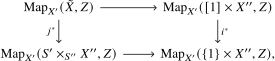 where the two vertical maps are equivalences since \(i\) and \(j\) are terminal. Hence there is
an equivalence
\[
\Map_{X'}(\tilde{X}, Z) \iso \Map_{X'}(S' \times_{S''} X'', Z)
\times_{\Map_{X'}(X'',Z)} \Map_{X'}([1] \times X'', Z).
\]
We now describe the retract explicitly. Denote the fiber product on the right by \(P_Z\), and
denote the displayed equivalence by
\[
e_Z\colon \Map_{X'}(\tilde{X},Z) \longrightarrow P_Z.
\]
Let \(r\colon \tilde{X}\to X'\) be the structural functor. Restricting the defining pullback
of \(\tilde{X}\) to \(\{0\}\times S'\), where \(\eta\) is the identity, gives a section
\(s\colon X'\to\tilde{X}\) with \(rs=\id_{X'}\).
Define \[ \pi_Z\colon P_Z\longrightarrow\Map_{X'}(X'',Z) \] by projecting to \(\Map_{X'}([1]\times X'',Z)\) and restricting along \(\{0\}\times X''\hookrightarrow[1]\times X''\). Conversely, the counit isomorphism identifies the composites of the projections below with the displayed structural maps to \(X'\). Precomposition with the projections \[ S'\times_{S''}X''\longrightarrow X'' \qquad\text{and}\qquad [1]\times X''\longrightarrow X'' \] defines a map \[ \sigma_Z\colon\Map_{X'}(X'',Z)\longrightarrow P_Z. \] The two resulting maps agree after restriction to \(\{1\}\times X''\), so \(\sigma_Z\) lands in the fiber product and \(\pi_Z\sigma_Z=\id\). The agreement at the \(1\)-endpoint uses the counit isomorphism \(v'\varepsilon\colon v'wv'\iso v'\) together with the triangle identity \(v'\varepsilon\circ\eta v' = \id_{v'}\). Thus, after pulling back to \(X''\), the \(1\)-endpoint of the path classified by \(\eta\) is identified with the structural map of \(X''\) over \(X'\).
By restriction to the two factors defining \(P_Z\), these maps form a commutative diagram in
the arrow category of animae:
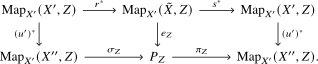 The horizontal composites are identities since \(rs=\id_{X'}\) and
\(\pi_Z\sigma_Z=\id\). Thus \((u')^*\) is a retract of the equivalence \(e_Z\), and is therefore
an equivalence. This proves that \(u'\) is terminal.
Theorem 9.4.6. Let \(p\colon E \to S\) be a functor, and assume that \(p\) satisfies the property that for any pullback diagram of the form
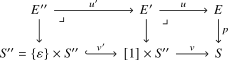 for \(\varepsilon = 1\) (resp. \(\varepsilon = 0\)) the base change \(u'\) is terminal (resp. initial). Then \(p\) is proper (resp. smooth).
Proof
We prove the statement for proper functors; the smooth case is dual. The strategy is to factor an arbitrary terminal functor into a fully faithful right adjoint, a localization, and a right fibration. The localization remains terminal after base change, the right-fibration factor is forced to be an equivalence, and the endpoint hypothesis handles the fully faithful factor.
Consider an arbitrary pullback diagram
in which \(v'\) is terminal. We need to show that also \(u'\) is terminal. To this end, we factor \(v'\) as
\[
S'' = S''_0 \xrightarrow{j} S''_1 \xrightarrow{\lambda} S''_2 = \Pi_{\infty}(S''_1/S') \xrightarrow{q} S',
\]
where \(j\) is a fully faithful right adjoint, \(\lambda\) is a localization and remains so after pullback, and \(q\) is a right fibration. Consider now the following commutative triangle:
 The functor \(j\) is terminal because it is a right adjoint, and \(\lambda\) is terminal because it is a localization. Thus their composite \(S''\to S''_2\) is terminal. Since \(v'=q\lambda j\) is terminal, cancellation shows that \(q\) is terminal. As \(q\) is also a right fibration, it is an equivalence by Lemma 9.1.7. Now consider the following pullback diagram:
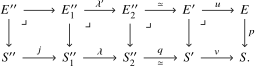 Since \(\lambda'\) is a localization, it is terminal by
Proposition 9.1.9. The functor \(E''\to E''_1\) is the pullback of
the fully faithful right adjoint \(j\). The relevant base change of \(p\) satisfies the
endpoint hypothesis because that hypothesis is stable under base change. Hence
Lemma 9.4.5 shows that
\(E''\to E''_1\) is terminal. The remaining map is an equivalence, so the composite
\(u'\colon E''\to E'\) is terminal.
Corollary 9.4.7. Any cocartesian fibration is proper. Any cartesian fibration is smooth.
Proof
Let \(p\colon E \to S\) be a cocartesian fibration and consider a pullback square of the following form:
Let \(p'\colon E'\to [1]\times S''\) denote the indicated base change of \(p\). Since \(p'\) is a cocartesian fibration and \(v'\) is a right adjoint, Proposition 6.2.4 shows that \(u'\) is a right adjoint, and hence terminal by Proposition 9.1.12. The claim now follows from Theorem 9.4.6.
Remark 9.4.8. The preceding corollary remains valid for locally cocartesian and locally cartesian fibrations.
Corollary 9.4.9. Any left fibration is proper. Any right fibration is smooth.
Corollary 9.4.10. Any projection of the form \(C \times D \to C\) is both smooth and proper.