Proposition 18.4.1. Let \(D\) be a compactly generated category and \(S\hookrightarrow\Map([1],D)\) a small family of morphisms between compact objects. Then the category of \(S\)-local objects \(L_S(D)\) is compactly generated.
Proof
By virtue of Theorem 18.1.6, the full embedding \[ L_S(D)\hookrightarrow D \] has a left adjoint \[ \loc_S\colon D\to L_S(D) \] that preserves compact objects. Let \(E\hookrightarrow D^\simeq\) be a small family of compact objects in \(D\). We denote by \(E_S\hookrightarrow L_S(D)^\simeq\) the image of the composed map \[ E\hookrightarrow D^\simeq\xrightarrow{\loc_S^\simeq}L_S(D)^\simeq\, . \] Proposition 11.2.18 ensures that \(E_S\) is small and all of its terms are compact objects of \(L_S(D)\). By construction, the map \(p\colon E\to E_S\) is a cover. It suffices now to check that the family of functors of the form \[ \Hom_{L_S(D)}(y,-)\quadtext{for all $y : E_S$} \] is conservative. Let \(f\colon a\to b\) be a morphism in \(L_S(D)\) such that \[ f_*\colon \Hom_{L_S(D)}(y,a)\xrightarrow{\simeq} \Hom_{L_S(D)}(y,b) \] is an isomorphism for all \(y : E_S^\simeq\). This implies that \[ f_*\colon \Hom_{L_S(D)}(p(x),a)\xrightarrow{\simeq} \Hom_{L_S(D)}(p(x),b) \] is an isomorphism for all \(x : E^\simeq\). But \(p(x)=\loc_S(x)\) and this means that \[ f_*\colon \Hom_{D}(x,a)\xrightarrow{\simeq} \Hom_{D}(x,b) \] is an isomorphism for all \(x : E^\simeq\). In other words, the image of \(f\) through the full embedding of \(L_S(D)\) into \(D\) is an isomorphism. Since full embeddings are conservative, this proves that \(f\) is an isomorphism in \(L_S(D)\).
Proposition 18.4.2. Let \(D\) be a compactly generated category and \(C\hookrightarrow D\) a small full subcategory such that \(C^\simeq\) is a generating family of compact objects in \(D\). We consider a family of morphisms \[ S\hookrightarrow\Map([1],C) \] with associated localization functor by \(S\)-equivalences \[ \loc_S\colon D\to L_S(D) \] We let \(W\hookrightarrow C\) be the subcategory of morphisms in \(C\) that become invertible in \(L_S(D)\) through the functor \(\loc_S\), with associated localization functor \(\gamma\colon C\to L(C)\), and we define \(C_S\) as the full subcategory of \(L_S(D)\) spanned by the image of the map \[ C^\simeq\hookrightarrow D^\simeq\xrightarrow{\loc_S^\simeq}L_S(D)^\simeq\, . \] Then there is a canonical equivalence \[ L(C)\simeq C_S\, . \]
Proof
The functor \(\loc_S\) obviously restricts to a right exact functor \[ l\colon C\to C_S \] that sends maps in \(W\) to isomorphisms. Corollary 17.1.8 (iv) implies that there is a unique right exact functor \[ \lambda\colon L(C)\to C_S \] equipped with an identification \(\lambda\circ\gamma=l\). We will prove that \(\lambda\) is an equivalence. Theorem 18.3.8 provides a canonical equivalence \[ \Lex(C\catop,\An)\simeq D \] extending the embedding \(C\hookrightarrow D\). The proof of Proposition 18.4.1 allows us to apply Theorem 18.3.8 once again to provide an equivalence of the form \[ \Lex(C_S\catop,\An)\simeq L_S(D) \] extending \(C_S\hookrightarrow L_S(D)\). Under these equivalences, the functor \[ l^*\colon \Lex(C_S\catop,\An)\to \Lex(C\catop,\An) \] corresponds to the full embedding \(L_S(D)\hookrightarrow D\).
On the other hand the functor
\[
\gamma^*\colon\PSh(L(C))\to\PSh(C)
\]
is fully faithful with essential image consisting of those presheaves on \(C\) which send
maps in \(W\) to isomorphisms of \(\An\). Corollary 17.1.8 (iii)
means that there is a canonical pullback square of the
form below.
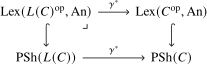 In particular the upper horizontal arrow above is a full embedding whose essential image consists
of those left exact presheaves on \(C\) sending maps in \(W\) to isomorphisms in \(\An\).
Under the equivalence \(\Lex(C\catop,\An)\simeq D\), those correspond to \(T\)-local objects
where
\[
T=\Map([1],W)\hookrightarrow\Map([1],C)\hookrightarrow\Map([1],D)\, .
\]
Since \(S\hookrightarrow T\), it is clear that any \(T\)-local object is \(S\)-local.
Conversely, any \(S\)-local object \(y\) is \(T\)-local: indeed, for any map \(u\colon a\to b\) in \(W\),
since \(\loc_S(u)\) is an isomorphism by definition of \(W\), the map
\[
u^*\colon \Hom_D(b,y)\to\Hom_D(a,y)
\]
is isomorphic to the isomorphism
\[
u^*\colon\Hom_D(\loc_S(b),y)\xrightarrow{\simeq}\Hom_D(\loc_S(a),y)\, .
\]
We obtain a commutative square of the form
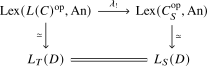 thus proving that the upper horizontal map is an equivalence.
In other words, the adjunction provided by Theorem 18.2.8
\[
\lambda_!\colon\Lex(L(C)\catop,\An)\rightleftarrows\Lex(C_S\catop,\An)\colon\lambda^*
\]
consists of equivalences. Since the restriction of \(\lambda_!\) to representable presheaves
is isomorphic to the composition of \(\lambda\) with the Yoneda embedding of \(C_S\), this proves that
the functor \(\lambda\) is fully faithful. Since
\[
\lambda^\simeq\colon L(C)^\simeq\to C_S^\simeq
\]
is a cover by construction, this proves that \(\lambda\) is an equivalence.
Notation 18.4.3. Recall that, for any category \(D\) with small colimits and any functor \(f\colon A\to B\) between small categories, the functor \[ f^*\colon\Fun(B,D)\to\Fun(A,D) \] has a left adjoint \[ f_!\colon\Fun(A,D)\to\Fun(B,D)\, . \] In particular, given any small category \(A\) and object \(a : A^\simeq\) the evaluation functor \(F\mapsto F_a\) has a left adjoint \[ D\to\Fun(A,D)\ , \quad x\mapsto a\otimes x \] defined by \(a\otimes x=a_!(x)\), where we see \(a\) as an \(A\)-valued functor. If \(D\) is locally small, we thus have the formula \[ \Hom(x,F_a)=\Hom(a\otimes x,F) \] functorially in \(x\) and \(F\), which determines \(a\otimes x\). Given a family of objects \(E\hookrightarrow D^\simeq\), we define \(E_A\) as the image of the map \[ A^\simeq\times E\to \Map(A,D)\ , \quad (a,x)\mapsto a\otimes x\, . \]
Proposition 18.4.4. Let \(D\) be a compactly generated category. For any small category \(A\), the functor category \(\Fun(A,D)\) is compactly generated. More precisely, given a small family of compact objects \(E\hookrightarrow D^\simeq\) that generates \(D\), the family \(E_A\) is a family of compact objects that generates \(\Fun(A,D)\).
Proof
Given \(a : A^\simeq\), the assignment \(F\mapsto F_a\) commutes with colimits and therefore, for any compact object \(x\) of \(D\), the object \(a\otimes x\) is compact: the functor \(\Hom(a\otimes x,-)\) is the composition of the evaluation at \(a\) with \(\Hom(x,-)\). One can detect isomorphisms in \(\Fun(A,D)\) object-wise, and can detect isomorphisms in \(D\) by evaluating on terms of \(E\). This shows that the family of functors of the form \(\Hom(a\otimes x,-)\) is jointly conservative.
Proposition 18.4.5. Let \(D\) be a compactly generated category. For any finite category \(A\), any functor \(F\colon A\to D\) taking values (objectwise) in compact objects of \(D\) is compact as an object of \(\Fun(A,D)\).
Proof
The assertion is clearly true if \(A=\emptyset\) or \(A=[0]\).
Let us prove it for \(A=[1]\). Given an object \(x\) of \(D\), and a morphism \(u\colon a\to b\) in \(D\),
there is a correspondence of the form
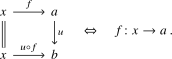 In other words, the object \(0\otimes x\)
can be described as the morphism
\[
\id_x\colon x\to x
\]
seen as a functor from \([1]\) to \(D\). Similarly, if \(\emptyset\) denotes the initial object of \(D\),
we see that the object \(1\otimes x\) corresponds to the unique morphism of the form
\[
\emptyset\to x\, .
\]
Given any morphism \(u\colon a\to b\) in \(D\)
there is a functor \(\varphi\colon \pushout\to \Fun([1],D)\)
yielding a diagram of the form
\[
0\otimes a\leftarrow 1\otimes a\to 1\otimes b
\]
corresponding to the commutative diagram below.
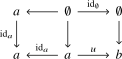 A simple inspection of universal properties shows that the colimit of this functor \(\varphi\)
is nothing else than \(u\colon a\to b\) (seen as a functor from \([1]\) to \(D\)).
By virtue of Lemma 18.1.3,
this proves that, if ever both \(a\) and \(b\) are compact in \(D\), so is \(u\) in \(\Fun([1],D)\).
Let \(C\hookrightarrow\Cat\) be the full subcategory of \(\Cat\) whose objects are those small categories such that any \(A\)-indexed functor with values in \(D_\omega\) is a compact object of \(\Fun(A,D)\). We know that \(C\) contains \(\emptyset\), \([0]\) as well as \([1]\). By virtue of Lemma 16.4.6, it suffices now to prove that \(C\) is stable under pushouts in \(\Cat\).
Let us consider a pushout square in \(\Cat\) of the form
 with \(A\), \(A'\) as well as \(B\) in \(C\).
Given a functor \(F\colon B'\to D\), we write \(F_V\colon V\to D\) for the composition
of \(F\) with the functor \(v\colon V\to B'\), for \(v\) being either \(u\), \(a\) or \(u'\).
We observe that the assignment \(F\mapsto F_V\) commutes with colimits (in particular with
small filtered ones).
For any functors \(F,G\colon B'\to D\), since we have a pullback square of the form
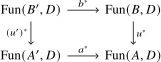 we have a canonical identification of the form
\[
\Hom(F,G)=\Hom(F_{A'},G_{A'})\times_{\Hom(F_{A},G_{A})}\Hom(F_{B},G_{B})\, .
\]
Since filtered colimits commute with pullbacks in \(\An\),
this shows that \(F\) is compact whenever \(F_V\) is compact in \(\Fun(V,D)\)
for \(V=A\), \(V=A'\), and \(V=B\). This implies right away that \(C\) is stable under pushouts in \(\Cat\)
and completes the proof of the proposition.
Lemma 18.4.6. Let \(P\) be a finite poset and \(C\) a small category with finite colimits. The restriction of the functor \[ P\times \Lex(C\catop,\An)\to \Fun(P\catop,\Lex(C\catop,\An))\ , \quad (a,x)\mapsto a\otimes x \] to \(P\times C\) via the Yoneda embedding of \(C\) takes values in the full subcategory \(\Fun(P\catop,C)\). This induces an equivalence \(\langle P\times C\rangle_\pf=\Fun(P\catop,C)\) (in other words, \(\Fun(P\catop,C)\) is the smallest finitely cocomplete full subcategory of \(\Fun(P\catop,\Lex(C\catop,\An))\) generated by objects of the form \(a\otimes x\) for \(a : P^\simeq\) and \(x : C^\simeq\)). In particular, we have \[ \Ind(\Fun(P\catop,C))=\Fun(P\catop,\Ind(C))\, . \]
Proof
The evaluation of \(a\otimes x\) at an object \(e\) of \(P\) is \[ \sum_{u : \Hom_P(e,a)}\, x\, . \] Since the order on \(P\) is decidable, the proposition \(\Hom_P(e,a)\) is decidable and hence is a finite set. This implies the first claim.
Therefore, in order to prove the second assertion, it suffices to know that any object of \(\Fun(P\catop,C)\) is a finite colimit of objects of the form \(a\otimes x\). The opposite \(P\catop\) is again a finite poset. The objects of \(\Tw(P\catop)\) form a decidable subobject of \((P\catop)^\simeq\times(P\catop)^\simeq\), and its order is decidable. Filtering a finite enumeration of the product therefore shows that \(\Tw(P\catop)\) is a finite poset. In particular, a new application of Proposition 16.4.23 tells us that \(\Tw(P\catop)\catop\) is a finite category. Therefore, Proposition 12.9.1 concludes the proof of the second assertion. The third one follows right away from the second one by Theorem 18.3.8.
Theorem 18.4.7. Let \(C\) be a small category with finite colimits and \(W\hookrightarrow C\) a subcategory closed under pushouts and with the \(2\)-out-of-\(3\) property, with associated localization functor \(\gamma\colon C\to L(C)\). Given a small category \(A\), we denote by \(L(\Fun(A,C))\) the localization of \(\Fun(A,C)\) by the family of natural transformations \(u\colon F\to G\) such that \(u_a\colon F_a\to G_a\) is a map of \(W\) for any object \(a : A^\simeq\). Then, for any finite poset \(P\), the functor \[ \gamma_*\colon\Fun(P,C)\to\Fun(P,L(C)) \] induces an equivalence \[ L(\Fun(P,C))\simeq\Fun(P,L(C))\, . \]
Proof
Recall that any finite poset is finite as a category (Proposition 16.4.23). Let us define \(D=\Fun(P,\Lex(C\catop,\An))\) and let \(S\hookrightarrow\Map([1],D)\) be the family of morphisms in \(\Fun(P,C)\) that are objectwise in \(W\). We see right away that \(S\)-local objects simply are left exact functors from \(L(C)\catop\) to \(\Fun(P,\An)\), hence that \[ D_S=\Fun(P,\Lex(L(C)\catop,\An))\, . \] Since, by virtue of Proposition 18.4.5 the Yoneda embedding \[ h_C\colon C\to\Lex(C\catop,\An) \] induces a full embedding \[ \Fun(P,C)\hookrightarrow D \] taking values in compact objects, Proposition 18.4.2 implies that the functor \[ \loc_S=(\gamma_!)_*\colon D\to D_S \] induces an equivalence \[ L(\Fun(P,C))=\Fun(P,C)_S \] where \(\Fun(P,C)_S\) is the full subcategory of \(\Fun(P,\Lex(L(C)\catop,\An))\) spanned by the essential image of the functor \[ \Fun(P,C)\xrightarrow{ \gamma_*}\Fun(P,L(C))\hookrightarrow D_S\, . \] This implies that the induced functor \[ L(\Fun(P,C))\to \Fun(P,L(C)) \] is right exact and fully faithful (right exactness was already known by Corollary 17.1.8 anyway). For any \(a : P^\simeq\) and any object \(x\) of \(C\), we see that the formation of \(a\otimes x\) commutes with \(\gamma\) by right exactness. Lemma 18.4.6 thus implies that the comparison functor is essentially surjective: its essential image is stable under finite colimits and contains all objects of the form \(a\otimes x\), hence everything.
Theorem 18.4.8. Let \(P\) be a finite poset. For any categories \(C\) and \(D\) with finite colimits, the canonical equivalence from Theorem 12.9.3 \[ \Fun_!(\Fun(P\catop,\Ind(C)),\Ind(D))\simeq \Fun_!(\Ind(C),\Fun(P,\Ind(D))) \] restricts to a functorial equivalence \[ \Rex(\Fun(P\catop,C),D)\simeq\Rex(C,\Fun(P,D))\, . \]
Proof
The equivalence is defined by sending any functor \(\Phi\colon\Fun(P\catop,\Ind(C))\to\Ind(D)\) to the transposition of the functor obtained by composing \(\Phi\) with the functor \[ P\times\Ind(C)\to\Fun(P\catop,\Ind(C))\ , \quad (a,x)\mapsto a\otimes x\, . \] On the other hand, since \(\Fun(P\catop,C)\) is the smallest full subcategory of \(\Fun(P\catop,\Ind(C))\) stable under finite colimits and containing objects of the form \(a\otimes x\) for \(a : P^\simeq\) and \(x : C^\simeq\), yielding the equivalence \[ \Ind(\Fun(P\catop,C))=\Fun(P\catop,\Ind(C))\, , \] by Lemma 18.4.6, we may see \(\Rex(\Fun(P\catop,C),D)\) as the full subcategory of the category \[ \Fun_!(\Fun(P\catop,\Ind(C)),\Ind(D)) \] spanned by those functors that send objects of the form \(a\otimes x\) to representable presheaves on \(D\) by Theorem 18.3.8. We also have similarly \[ \Fun_!(\Ind(C),\Fun(P,\Ind(D))) =\Rex(C,\Fun(P,\Ind(D))) \] by another application of Theorem 18.3.8.
In other words, we have a pullback square of the form:
 in which the upper horizontal map must be an equivalence.
Remark 18.4.9. We can also give an alternative proof of Theorem 18.4.7 using Theorem 18.4.8 instead of Proposition 18.4.2 (exercise left to the reader).
Remark 18.4.10. One can understand the functoriality of the equivalence provided by the previous theorem. Given a functor between finite posets \(u\colon P\to Q\), if \(C\) has finite colimits, if \(u^*(F)=F\circ u\), there is an adjunction \[ u_!\colon\Fun(P,\Ind(C))\rightleftarrows\Fun(Q,\Ind(C))\colon u^* \] and the formula \[ u_!(F)(y)=\underset{x : P\, , \, u(x)\leq y}{\colim}\, {F(x)} \] The indexing poset is finite: the predicate \(u(x)\leq y\) is decidable, so it filters a finite enumeration of \(P\) to a finite enumeration of this full subposet. Consequently, this formula shows that the adjunction restricts to one of the form \[ u_!\colon\Fun(P,C)\rightleftarrows\Fun(Q,C)\colon u^*\, . \] There is thus a functor \[ (u\catop)_!\colon\Fun(P\catop,C)\to\Fun(Q\catop,C) \] inducing a functor \[ ((u\catop)_!)^*\colon\Rex(\Fun(Q\catop,C),D)\to\Rex(\Fun(P\catop,C),D)\, . \] For \(a : P\) and \(x : C\), we have \[ (u\catop)_!(a\otimes x)=u(a)\otimes x\, . \] This means that the functor \(((u\catop)_!)^*\) above corresponds under the correspondence of the previous theorem to the functor of type \[ \Rex(C,\Fun(Q,D))\to\Rex(C,\Fun(P,D)) \] defined by \(\varPsi\mapsto u^*\varPsi\).
On the other hand, since both \((u\catop)_!\) and its right adjoint \((u\catop)^*\) are right exact, the induced adjunction \[ ((u\catop)^*)^*\colon\Fun(\Fun(P\catop,C),D)\rightleftarrows\Fun(\Fun(Q\catop,C),D)\colon((u\catop)_!)^* \] restricts to an adjunction \[ ((u\catop)^*)^*\colon\Rex(\Fun(P\catop,C),D)\rightleftarrows\Rex(\Fun(Q\catop,C),D)\colon((u\catop)_!)^*\, . \] Therefore, \(((u\catop)^*)^*\) corresponds to the functor of type \[ \Rex(C,\Fun(P,D))\to\Rex(C,\Fun(Q,D)) \] defined by \(\varPhi\mapsto u_!\varPhi\).
If furthermore \(u\) has a right adjoint \(v\colon Q\to P\), then \[ (v\catop)_!=(u\catop)^*\, . \] This means that \((u\catop)^*\) has a further right adjoint, namely \((v\catop)^*\), that one can interpret through the correspondence of Theorem 18.4.8 as well.