The results of Chapter 6 allow us to assemble limits and colimits into functors. We express this using adjoints to the constant-diagram functor.
Definition 7.2.1. Let \(I\) and \(C\) be categories. We say that \(C\) admits \(I\)-indexed limits (resp. colimits) if the constant-diagram functor \(p_I^*\colon C \to \Fun(I,C)\) admits a right (resp. left) adjoint \[ \lim_I\colon \Fun(I,C) \to C \qquad \qquad \text{( resp. } \colim_I\colon \Fun(I,C) \to C). \]
For \(I=\{0,1\}\), we say that \(C\) admits binary products or binary coproducts, respectively. Likewise, \(C\) admits pullbacks if it admits \(\pullback\)-indexed limits, and admits pushouts if it admits \(\pushout\)-indexed colimits.
As in Convention 5.4.4, “for every diagram \(F\colon I\to C\)” refers to the universal diagram in context \(\Map(I,C)\), with \(I\) and \(C\) weakened to that context.
Proposition 7.2.2. A category \(C\) admits \(I\)-indexed colimits if and only if for every diagram \(F\colon I \to C\), there exists a colimit \(\colim_I F\). The dual statement holds for limits.
Proof
Apply Theorem 6.2.1 and its dual to the constant-diagram functor \(C\to\Fun(I,C)\). Its relative slices and coslices are precisely the categories of cones and cocones.
Definition 7.2.3. Let \(I\) be a category and let \(f\colon C \to D\) be a functor. If \(C\) and \(D\) admit \(I\)-indexed colimits, we say that \(f\) preserves \(I\)-indexed colimits if the commutative diagram
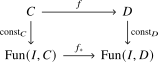 is left-adjointable, in the sense that the Beck–Chevalley map
\[
\BC\colon \colim_I \circ f_* \to f \circ \colim_I
\]
is a natural isomorphism of functors \(\Fun(I,C) \to D\). Preservation of \(I\)-indexed limits is defined dually.
We can also express preservation in terms of individual colimit cocones.
Proposition 7.2.4. Let \(C\) and \(D\) admit \(I\)-indexed colimits. A functor \(f\colon C \to D\) preserves \(I\)-indexed colimits if and only if for every \(I\)-indexed diagram \(F\colon I \to C\) and every colimit cocone \((\colim_I F, \varepsilon)\) for \(F\), the induced cocone \((f(\colim_I F), f(\varepsilon))\) is a colimit cocone for \(f \circ F\).
Proof
The component of the Beck–Chevalley transformation at \(F\) is the morphism \(\colim_I(f\circ F)\to f(\colim_I F)\) induced by the displayed cocone. It is an isomorphism precisely when that cocone is a colimit cocone. The assertion follows from Proposition 3.4.6.
Lemma 7.2.5 (Adjoints preserve (co)limits). Let \(f\colon C \to D\) be a functor and let \(I\) be a category such that both \(C\) and \(D\) admit \(I\)-indexed colimits. If \(f\) admits a right adjoint \(g\colon D \to C\), then \(f\) preserves \(I\)-indexed colimits. The dual statement that right adjoints preserve limits also holds.
Proof
We have to show that the Beck–Chevalley transformation in the diagram
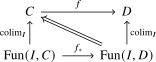 is a natural isomorphism. By passing to right adjoints, this is equivalent to showing that the Beck–Chevalley transformation in the diagram
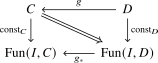 is a natural isomorphism. But this is clear since the adjunction \(f_* \colon \Fun(I,C) \rightleftarrows \Fun(I,D) \noloc g_*\) is natural in \(I\).