Theorem 15.1.11 (Abstract nerve theorem). Let \(A\) be small and let \(i\colon A\to\Cat\) be fully faithful. If \((A,i)\) admits a décalage structure, then the functor \[ i^*\colon\Cat\to\PSh(A) \] defined by the rule \(C\mapsto (a\mapsto\Hom_\Cat(i(a),C))\) is fully faithful.
Proof
For a small category \(C\), it suffices to show that the counit
\(\varepsilon_C\colon Li_!(i^*(C))\to C\) is an equivalence.
Identify \(A_{/i^*(C)}\) with \(A_{/C}\). The counit is induced by the
evaluation maps \(\gamma\colon i(a)\to C\), so naturality of \(\tau\) in
Construction 15.1.8 gives the
commutative triangle
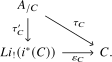 By Lemma 15.1.9, \(\tau_C\) is the localization
at last vertex morphisms. By
Lemma 15.1.10, so is \(\tau'_C\).
The triangle therefore identifies \(\varepsilon_C\) with the equivalence
between these two localizations.