Construction 15.1.8. Let \(i\colon A\to\Cat\) be fully faithful and equipped with a
décalage structure. Pull back the universal cocartesian fibration:
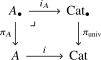 The functor \(\pi_A\) is a cocartesian fibration whose fiber over each object \(a\) is
the category with terminal object \(i(a)\). In particular, it has a fully faithful right
adjoint
\[
e\colon A\to A_\bullet
\]
defined by \(e(a)=e_a\) on objects.
The nerve and its left adjoint form an adjunction
\[
Li_!\colon\PSh(A)\rightleftarrows\Cat\colon i^*
\]
Given a presheaf \(X\colon A\catop\to\An\), we form the pullback squares below.
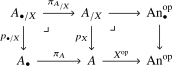 In other words, we have:
\[
A_{\bullet/X}= \int_{(a,\gamma) : A_{/X}}i(a)\, .
\]
Observe that the functor \(\pi_{A_{/X}}\) has a right adjoint section,
being the pullback of a functor with this property.
The assumption of full faithfulness on \(i\) implies that
there are canonical isomorphisms of the form
\[
A_{/a}\iso A_{/i(a)}
\]
defined by sending \((a',u\colon a'\to a)\) to \((a',i(u)\colon i(a')\to i(a))\).
The canonical isomorphism deduced from Lemma 13.3.4
\[
\colim_{(a,\gamma) : A_{/X}} A_{/a}\iso A_{/X}
\]
can thus be rewritten as
\[
\colim_{(a,\gamma) : A_{/X}} A_{/i(a)}\iso A_{/X}\, .
\]
Naturality of last-vertex evaluation gives functors
\(\tau_{i(a)}\colon A_{/i(a)}\to i(a)\).
Since
\[
\colim_{(a,\gamma) : A_{/X}} i(a)=Li_!(X)
\]
by construction, we obtain the commutative diagram
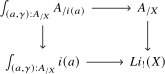 in which both horizontal maps
are localizations at cocartesian morphisms with respect to the projection to \(A_{/X}\).
On the other hand, the vertical arrow on the left is fiberwise a localization
as well as a cocartesian functor over \(A_{/X}\). Therefore, it is also a localization
by Theorem 8.8.9.
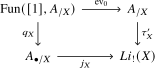
Furthermore, for each object \((a,\gamma)\) of \(A_{/X}\), \(\gamma\colon h_A(a)\to X\),
there are functorial equivalences of the form
\[
(A_{/X})_{/(a,\gamma)}\simeq A_{/a}\simeq A_{/i(a)}
\]
and we have an equivalence
\[
\Fun([1],A_{/X})\simeq \int_{(a,\gamma) : A_{/X}}(A_{/X})_{/(a,\gamma)}
\]
over \(A_{/X}\), with \(\ev_1\colon\Fun([1],A_{/X})\to A_{/X}\) as structural map.
These identifications give the commutative square
 Since \(i\) is fully faithful, the terminal object of \(i(a)\) is determined by a unique map \(e_a\colon\omega\to a\)
in \(A\). We will say that a map \(u\colon a\to b\) in \(A\) is a last vertex morphism
if \(u\circ e_a\simeq e_b\) holds (such an isomorphism, if it exists, is necessarily unique).