Theorem 6.6.3 (Fiberwise recognition of relative right adjoints). Let \(p\colon C\to S\) and \(q\colon D\to S\) be cocartesian fibrations, and let \(L\colon C\to D\) be a functor over \(S\). The following conditions are equivalent:
(1) The functor \(L\) admits a right adjoint relative to \(S\);
(2) The functor \(L\) is cocartesian over \(S\), and every fiber functor \(L_s\colon C_s\to D_s\) admits a right adjoint \(R_s\colon D_s\to C_s\).
Under these conditions, the restriction of the relative right adjoint to \(D_s\) is right adjoint to \(L_s\).
Proof
Suppose first that \(L\dashv R\) is an adjunction relative to \(S\). In context \(s:S^{\simeq}\), base change along \(s\colon *\to S\) gives an adjunction \(L_s\dashv R_s\) by Proposition 4.4.31.
To show that \(L\) preserves cocartesian morphisms, let \(a\colon x\to x'\) be
\(p\)-cocartesian over \(u\colon s\to t\). For any object \(y\) of \(D\), the relative
adjunction gives a commutative diagram
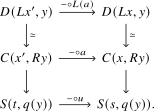 The lower square is a pullback since \(a\) is \(p\)-cocartesian. The vertical arrows
in the upper square are equivalences, so the outer square is a pullback as well.
Thus \(L(a)\) is \(q\)-cocartesian, and \(L\) is cocartesian by
Lemma 4.7.3.
Conversely, suppose that \(L\) is cocartesian and fix fiberwise adjunctions \(L_t\dashv R_t\). For \(y : D_t\), let \[ \varepsilon_y\colon L_tR_ty\longrightarrow y \] be the fiberwise counit. We claim that this is also a universal morphism from \(L\) to \(y\): for every \(x : C_s\), the map \[ C(x,R_ty)\longrightarrow D(Lx,y),\qquad h\longmapsto\varepsilon_yL(h) \] is an equivalence. Since \(\varepsilon_y\) lies over \(\id_t\), this map commutes with the projections to \(S(s,t)\). We may therefore check the claim on fibers over \(u\colon s\to t\), where cocartesian transport and the fiber adjunction give \[ C(x,R_ty)_u \simeq C_t(u_!x,R_ty)\simeq D_t(L_tu_!x,y) \simeq D_t(u_!L_sx,y)\simeq D(Lx,y)_u. \] Here the third equivalence uses that \(L\) preserves cocartesian transport. To identify the composite, write \(h=\bar h\lambda\), where \(\lambda\colon x\to u_!x\) is the chosen lift. The fiber adjunction sends \(\bar h\) to \(\varepsilon_yL(\bar h)\); the remaining maps compose this with \(L(\lambda)\). Their composite is therefore \(\varepsilon_yL(h)\), as required. The map is an equivalence on every fiber, hence an equivalence by Lemma 6.1.12. The pointwise criterion Proposition 6.2.3 therefore produces a right adjoint \(R\colon D\to C\) whose value on \(y : D_t\) is \(R_ty\) and whose counit has component \(\varepsilon_y\).
Applying \(q\) to the counit and using \(qL = p\) gives a transformation \(pR\to q\) whose component at \(y : D_t\) is \(\id_t\). By Proposition 3.4.6, it is a natural isomorphism and equips \(R\) with the structure of a functor over \(S\). With this structure, the counit lies in \(\Fun_S(D,D)\). Thus \(L\dashv R\) is relative to \(S\) by Definition 4.4.28.