Proposition 6.6.4 (Relative left-adjoint criterion). Let \(p\colon C\to S\) and \(q\colon D\to S\) be cocartesian fibrations, and let \(R\colon D\to C\) be a functor over \(S\). Fix fiberwise adjunctions \(L_s\dashv R_s\). Then \(R\) admits a left adjoint relative to \(S\) inducing these fiberwise adjunctions if and only if the transformation \(\theta_u\) of (6.13) is invertible for every morphism \(u\colon s\to t\) in \(S\). When these conditions hold, the relative left adjoint is cocartesian, and its Beck–Chevalley transformation over \(u\) is \(\theta_u^{-1}\).
Proof
Suppose first that \(L\dashv R\) is a relative adjunction inducing the chosen fiberwise
adjunctions. Then
Theorem 6.6.3 shows that \(L\) is cocartesian. Let
\(\overline u^L\colon u_!L_s\to L_tu_!\) be its Beck–Chevalley transformation.
For the chosen lift \(\lambda\colon x\to u_!x\) in \(C\), naturality of the unit gives
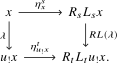 The lift functor makes this a square of natural transformations of functors \(C_s\to C\).
Factoring through the chosen cocartesian lifts, the right-hand morphism gives
\(R_t\overline u^L\circ\overline u^R L_s\), while the upper morphism gives \(u_!\eta^s\).
The universal property of these lifts therefore gives
\[
\eta^t u_!=R_t\overline u^L\circ\overline u^R L_s\circ u_!\eta^s
\]
in \(\Fun(C_s,C_t)\). Since \(\overline u^L\) is invertible, we obtain
\[
R_t(\overline u^L)^{-1}\circ\eta^t u_!
=
\overline u^R L_s\circ u_!\eta^s.
\]
The characterization (6.14) therefore
identifies \(\theta_u\) with \((\overline u^L)^{-1}\). In particular, \(\theta_u\) is invertible.
Conversely, suppose that every \(\theta_u\) is invertible. For \(x : C_s\), we claim that the fiberwise unit \(\eta_x^s\colon x\to R_sL_sx\) is a universal morphism from \(x\) to \(R\). For every \(y : D_t\), we must therefore show that \[ D(L_sx,y)\longrightarrow C(x,Ry),\qquad g\longmapsto R(g)\eta_x^s \] is an equivalence. This map again commutes with the projections to \(S(s,t)\). On the fiber over \(u\colon s\to t\), cocartesian transport and the fiber adjunction give \[ D(L_sx,y)_u \simeq D_t(u_!L_sx,y)\simeq D_t(L_tu_!x,y) \simeq C_t(u_!x,R_ty)\simeq C(x,Ry)_u, \] where the second equivalence is precomposition with \(\theta_u\). To identify the composite, write \(g=\bar g\lambda\) for the chosen lift \(\lambda\colon L_sx\to u_!L_sx\) in \(D\). The middle two equivalences send \(\bar g\) to \[ R_t(\bar g)R_t(\theta_{u,x})\eta^t_{u_!x} =R_t(\bar g)\overline u^R_{L_sx}u_!(\eta_x^s) \] by (6.14). Composing with the lift \(x\to u_!x\) gives \(R(g)\eta_x^s\), by the definition of \(\overline u^R\) and naturality of the chosen lifts. Thus the displayed map is an equivalence on every fiber, hence an equivalence by Lemma 6.1.12. The left-adjoint form of Proposition 6.2.3 produces a left adjoint \(L\colon C\to D\) with the prescribed values and unit components.
Applying \(p\) to the unit and using \(pR=q\) gives a natural transformation \(p\to qL\). Its components are identities, so it is invertible by Proposition 3.4.6. Its inverse equips \(L\) with the structure of a functor over \(S\), with respect to which the unit lies over \(S\). By Proposition 4.4.29, the adjunction is therefore relative to \(S\). Applying Theorem 6.6.3 shows that \(L\) is cocartesian. The necessity argument above, applied to this relative adjunction, then identifies \(\theta_u\) with \((\overline u^L)^{-1}\) for every \(u\).