Proposition 19.6.1. Let \(C\) be a stable category and \(W\) a family of maps in \(C\) with the \(2\)-out-of-\(3\) property and stable under pullbacks. We also assume that one of the following conditions is verified:
(i) \(W\) is also stable under pushouts;
(ii) \(W\) is stable under the suspension functor \(\Sigma\colon C\to C\).
The localization \(L(C)\) of \(C\) by \(W\) is then stable and the localization functor \(\gamma\colon C\to L(C)\) is exact.
Proof
We know that \(L(C)\) is pointed left exact and that the localization functor \[ \gamma\colon C\to L(C) \] is left exact by Theorem 17.1.5.
Under condition (i), we can apply dually Corollary 17.1.8 and see that \(L(C)\) has pushouts and that \(\gamma\) is right exact (Proposition 14.1.1 and its dual version ensure that \(L(C)\) has a terminal object that is also initial and that \(\gamma\) preserves those). The proof of Theorem 17.1.5 (iv) tells us that the collection of pullback squares of \(C\) covers the collection of pullback squares of \(L(C)\). Since all pullback squares of \(C\) also are pushout squares, and since \(\gamma\) is exact, this implies that all pullback squares of \(L(C)\) are pushouts. Applying the previous argument to \(C\catop\) shows that all pushout squares of \(L(C)\) are pullback squares as well.
Under condition (ii), Lemma 14.1.5 tells us that the adjunction equivalence \[ \Sigma\colon C\rightleftarrows C\colon \Omega \] induces an adjunction equivalence after localization, which implies right away that \(\Omega\colon L(C)\to L(C)\) is an equivalence of categories. Therefore, \(L(C)\catop\) is stable, and thus so is \(L(C)\) itself.
Definition 19.6.2. Let \(i\colon A\to B\) be an exact full embedding between stable categories.
The Verdier quotient of \(B\) by \(A\) is the stable category \(B/A\) defined by forming the
pushout square
 in the category \(\StabCat\) of stable categories
(that are small for a big enough universe), where \(0\) denotes the terminal stable category.
Remark 19.6.3. In the commutative square defining \(B/A\) above, the commutativity constraint expressing that \(p\circ i\) is the constant functor taking the value \(0\) in \(B/A\) is unique: the \(0\) functor is a terminal object in the category of exact functors from \(A\) to \(B/A\).
Lemma 19.6.4. In a stable category \(C\), for any morphism \(u\colon x\to y\) in \(C\), the cofiber of \(u\) is canonically isomorphic to the suspension of its fiber.
Proof
This follows right away from the fact that in the commutative diagram
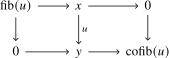 both squares are pullbacks as well as pushouts.
Lemma 19.6.5. Let \(C\) be a stable category and
 a pullback (hence also a pushout) square in \(C\).
Then \(u\) is an isomorphism if and only if \(u'\) is an isomorphism.
Proof
In a pullback square as in the lemma, if \(u\) is invertible, so is \(u'\). The dual statement for pushouts implies the converse.
Lemma 19.6.6. Let \(u\colon x\to y\) be a morphism in a stable category \(C\). The following assertions are equivalent.
(i) The morphism \(u\) is an isomorphism.
(ii) The fiber of \(u\) is isomorphic to \(0\).
(iii) The cofiber of \(u\) is isomorphic to \(0\).
Proof
It follows immediately from Lemma 19.6.4 that conditions (ii) and (iii) are equivalent. We deduce right away from Lemma 19.6.5 that conditions (i) and (ii) are equivalent.
Proposition 19.6.7. Let \(i\colon A\to B\) be a fully faithful exact functor between stable categories. The family \(W\) of morphisms of \(B\) with fibers in \(A\) agrees with the family of morphisms of \(B\) with cofibers in \(A\). Moreover \(W\) is stable under pullbacks as well as under pushouts, and the resulting localization of \(B\) by \(W\) is nothing else than the Verdier quotient \(B/A\).
Proof
The first assertion follows right away from Lemma 19.6.4. The stability of \(W\) under pullbacks is obvious, since fibers remain constant through pullbacks. Stability under pushouts follows by a dual argument. For composable morphisms \(f\) and \(g\), the cofiber sequence \(\cofib(f)\to\cofib(gf)\to\cofib(g)\) shows that \(W\) has the \(2\)-out-of-\(3\) property, since \(A\) is a full stable subcategory. Thus Proposition 19.6.1 shows that \(L(B)\) is stable and the localization functor \(\gamma\colon B\to L(B)\) is exact. By Corollary 17.3.7, precomposition with \(\gamma\) therefore identifies exact functors \(L(B)\to C\) with exact functors \(B\to C\) inverting \(W\), for every stable category \(C\).
Given an exact functor \(\varphi\colon B\to C\), using Lemma 19.6.6,
we see that the property for \(\varphi\) to send any map in \(W\) to an isomorphism in \(C\) is equivalent
to the property of sending any object of \(A\) to \(0\) in \(C\).
Consequently,
there is a pullback square of the form
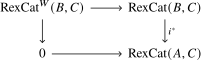 which identifies \(L(B)\) with the pushout defining \(B/A\).
Corollary 19.6.8. Let \(i\colon A\to B\) be an exact full embedding between small stable categories with corresponding Verdier quotient \(p\colon B\to B/A\). The induced functor \[ p^*\colon\Lex((B/A)\catop,\Sp)\to\Lex(B\catop,\Sp) \] is fully faithful. Given an exact functor of the form \[ F\colon B\catop\to\Sp\, , \] the following assertions are equivalent.
(i) The functor \(F\) belongs to the essential image of \(p^*\).
(ii) The functor \(i^*(F)=F\circ i\catop\) is constant with value \(0\).
(iii) We have \(F(i(a)) = 0\) in \(\Sp\) for any object \(a\) of \(A\).
(iv) We have \(\Omega^\infty(F(i(a)))\simeq*\) in \(\An_\bullet\) for any object \(a\) of \(A\).
Proof
The fact that the functor \(p^*\) is fully faithful with essential image described by condition (ii) is a direct consequence of the description of the universal property exhibiting \(B/A\) as a localization provided by Proposition 19.6.7, using Remark 18.5.6 and the left exact version of Corollary 17.3.7. Conditions (ii) and (iii) obviously are equivalent. Since \[ \Omega^\infty\colon\Lex(C\catop,\Sp)\to\Lex(C\catop,\An_{\bullet}) \] is an equivalence for any small stable category \(C\), all of the above may be repeated replacing \(\Sp\) by \(\An_{\bullet}\) and this implies that conditions (iii) and (iv) are equivalent.
Remark 19.6.9. Let \(i\colon A\to B\) be an exact fully faithful functor between small stable categories, with Verdier quotient. Let \(W\) be the family of maps with fibers in \(A\).
Using the Yoneda embedding \[ B\hookrightarrow\Ind(B)=\Lex(B\catop,\Sp) \] we may see \(W\) as a small family of maps in \(\Ind(B)\). The \(W\)-local objects are thus those presheaves satisfying condition (iii) of Corollary 19.6.8. More precisely, if \(L_W\Ind(B)\) denotes the full subcategory of \(W\)-local objects in \(\Ind(B)\), the functor \(p^*\) induces a fully faithful and essentially surjective functor from \(\Ind(B/A)\) to \(L_W\Ind(B)\). Since \(p^*\) corresponds to the full embedding of \(L_W\Ind(B)\) to \(\Ind(B)\), its left adjoint \[ p_!\colon\Ind(B/A)\to\Ind(B) \] correspond to the \(W\)-localization functor \[ \loc_W\colon L_W\Ind(B)\to\Ind(B)\, . \] One can then use Proposition 18.4.2 to identify the localization of \(B\) by \(W\) with the smallest full subcategory of \(\Ind(B/A)\) stable under pushouts and containing objects of the form \(p(b)\) for \(b : B^\simeq\). Let \(\gamma\colon B\to L(B)\) be this localization.
We also get a Verdier quotient
of the form
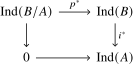 since \(i^*\) is a localization (having a fully faithful left adjoint \(i_!\)) and that the
objects of \(\Ind(B)\) that are sent to \(0\) through \(i^*\) precisely are the objects in the
essential image of \(p^*\) by Corollary 19.6.8,
so that we can apply Proposition 19.6.7
(for large stable categories, i.e. seeing \(\Ind(B)\) as a stable category in larger universe).
Definition 19.6.10. A six gluing functors datum is a diagram of stable categories of the form
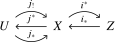 in which all functors are exact,
with the following properties.
(i) We have \(i^*\circ j_! = 0\).
(ii) Both functors \(j_!\) and \(i_*\) are fully faithful.
(iii) The functor \(j^*\) is right adjoint to \(j_!\) and left adjoint to \(j_*\).
(iv) The functor \(i^*\) is left adjoint to \(i_*\).
(v) The pair \((j^*,i^*)\) is jointly conservative: for any object \(x : X^\simeq\), we have \(x= 0\) if and only if \(j^*(x)=0\) and \(i^*(x)=0\).
Remark 19.6.11. If we have a six gluing functors datum as above, then, for any object \(x\) of \(X\) the following square
induced by the co-unit of the adjunction \((j_!,j^*)\) and by the unit of the adjunction \((i^*,i_*)\)
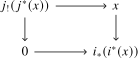 is a cofiber sequence in \(X\) (there is a unique way to make this square commutative
by condition (i)).
Indeed, it suffices to prove that the induced map from the cofiber of the co-unit
map \(j_!(j^*(x))\to x\) to \(i_*(i^*(x))\) is an isomorphism. By condition (v) of the definition, this means that it
suffices to check that the two commutative squares
 are cofiber sequences. But they are isomorphic to
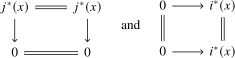 respectively, which are obviously cocartesian squares.
We define then a functor
\[
i^!\colon X\to Z
\]
by assigning to each \(x : X\) a fiber sequence of the form
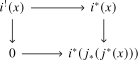 where the vertical map on the right side is the image by \(i^*\) of the unit
map of the adjunction \((j^*, j_*)\).
We can define \(I(x)\) through the pullback square
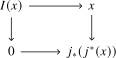 and observe that since \(j^*\) sends the vertical map on the right side to an isomorphism,
we have \(j^*(I(x))=0\). In other words the cofiber sequence
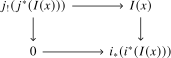 shows that the unit map \(I(x)\to i_*(i^*(I(x)))\) is an isomorphism.
Since \(i^*(I(x))=i^!(x)\) essentially by definition, we thus have
\[
I(x)=i_*(i^!(x))
\]
and this yields a canonical fiber sequence of the form below.
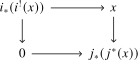 Remark that since \(i_*\) is fully faithful, \(i^*\circ i_*\) is the identity and thus the fiber
sequence above may be taken as a definition of \(i^!(x)\) as well.
The following lemma explains why we speak of six gluing functors.
Lemma 19.6.12. With a six gluing functors datum as above, the functor \(i^!\colon X\to Z\) introduced in the previous remark is right adjoint to \(i_*\).
Proof
Given \(x\) in \(X\) and \(z\) in \(Z\), since \(i_*\) is fully faithful, it suffices
to prove that
\[
\Hom(i_*(z),i_*i^!(x))=\Hom(i_*(z),x)
\]
This will follow from an identification of the form
\[
\SpHom(i_*(z),i_*i^!(x))=\SpHom(i_*(z),x)
\]
by applying \(\Omega^\infty\).
By construction of \(i^!\), for any \(a\) and \(x\) in \(X\), we have
a pullback square of the form below.
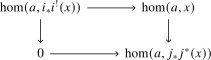 We want to prove that the upper horizontal map is invertible whenever \(a\) is of the form \(i_*(z)\).
By virtue of Lemma 19.6.6
it suffices to prove that
\[
\SpHom(i_*(z),j_*(u))=0
\]
for all \(z\) in \(Z\) and all \(u\) in \(U\). But \(j^*\) is left adjoint to \(j_*\) so that
this amounts to proving the relation \(j^*\circ i_*=0\). This follows from
the relation \(i^*\circ j_!=0\) and from Theorem 19.4.3 by transposition:
\[
\SpHom(a,j^*\, i_*(b))=\SpHom(i^*\, j_!(a),b)\, .
\]
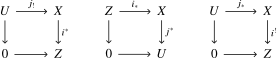
Proposition 19.6.13. We consider a six gluing functors datum of the form below, with \(X\), \(U\) and \(Z\) small.
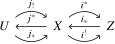 Then all commutative squares below are both pullbacks and pushouts in \(\StabCat\).
Proof
We first prove that each square is a pullback square of stable categories.
Since all functors \(j_!\), \(j_*\) and \(i_*\) are fully faithful, it suffices to check this
on objects. For the first two squares, this follows right away from the pushout squares of the
form
for each \(x : X^\simeq\).
For the third one, this follows from the pullback squares of the form
for each \(x : X^\simeq\).
Finally, each functor with a fully faithful left or right adjoint is a localization. In the case of exact functors between stable categories, an exact localization is always obtained by inverting the morphisms whose fiber becomes zero in the localization. Therefore, the description of Verdier quotients as localizations provided by Proposition 19.6.7 ends the proof.
Construction 19.6.14. Given a small stable category \(C\), we will write \(C'=\Ind(C)_\omega\) for its
idempotent completion. Each exact functor \(u\colon C\to D\) between small stable categories
induces an exact functor
\[
u_!\colon\Ind(C)\to\Ind(D)
\]
that preserves compact objects and thus restricts to an exact functor after idempotent completions:
\[
u'\colon C'\to D'\, .
\]
The naturality of the Yoneda embedding yields a commutative square of the form
 in which the two vertical maps are fully faithful exact functors.
Theorem 19.6.15 (Thomason). Let \(i\colon A\to B\) be a fully faithful exact functor between small stable categories,
and let \(B/A\) be the associated Verdier quotient.
 By passing to idempotent completions, we obtain a cartesian square in \(\StabCat\)
of the form
 with \(i'\) fully faithful, and the induced functor
\[
B'/A'\to (B/A)'
\]
is an exact fully faithful functor that induces an equivalence after idempotent completion
\[
(B'/A')'\simeq(B/A)'\, .
\]
Moreover, the induced commutative square of (large) stable categories
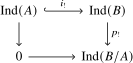 has the property that \(i_!\) is fully faithful and that \(p_!\) induces an equivalence
\[
\Ind(B)/\Ind(A)\simeq\Ind(B/A)\, .
\]
Proof
Since \(i\) is fully faithful, the induced functor \[ i_!\colon\PSh(A)\to\PSh(B) \] is fully faithful, hence its restriction \[ i_!\colon\Ind(A)\to\Ind(B) \] is fully faithful as well. Restricting further to compact objects thus yields an exact fully faithful functor \[ i'\colon A'\to B'\, . \] Since \(\Ind(C)=\Ind(C')\) for any small stable category \(C\), Remark 19.6.9 implies right away that the comparison functor \[ B/A\to B'/A' \] is fully faithful and induces an equivalence \[ \Ind(B/A)=\Ind(B'/A')\, . \] Passing to compact objects, this proves that \(B/A\) and \(B'/A'\) have the same idempotent completion.
Let us consider finally the commutative square in \(\StPrL_\omega\)
given by
In order to prove that this is both a pullback square and a pushout square of (large)
stable categories, we will apply Proposition 19.6.13.
In other words, it suffices to check that we have a six gluing functors datum
of the form
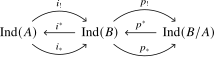 The existence of adjoint functors follows from
Theorem 18.2.8 and
Proposition 19.3.5. The only non-trivial property to be checked is the fact that
\(i^*\) and \(p_!\) form a jointly conservative family of functors. In other words, we have to check that, for
an object \(X\) of \(\Ind(B)\) with \(i^*(X)=0\) and \(p_!(X)=0\) we must have \(X=0\).
But by Corollary 19.6.8, the condition that \(i^*(X)=0\)
is equivalent to the condition that \(X\) is in the essential image of \(p^*\). If \(X=p^*(Y)\)
for some \(Y\), since \(p^*\) is fully faithful, we then have \(p_!(X)=Y\). Therefore, if \(p_!(X)=0\)
we must have \(Y=0\) hence \(X=0\) as well. Since \((-)_\omega\) preserves pullback squares (being a right adjoint),
this proves the theorem.
Definition 19.6.16. Let \(B\) be a stable category. A thick subcategory of \(B\) is a fully faithful exact functor \(i\colon A\to B\) with the property that, for any projector of the form \(p\colon x\to x\) in \(A\), if \(i(p)\) has an image in \(B\), then \(p\) has an image in \(A\). We will then say by a slight abuse that \(A\) is a thick subcategory of \(B\).
Proposition 19.6.17. Let \(i\colon A\to B\) be a fully faithful exact functor between stable categories. We denote by \(\gamma\colon B\to B/A\) the associated Verdier quotient. The following conditions are equivalent.
(i) The commutative square
 is a pullback square.
(ii) \(A\) is a thick subcategory of \(B\).
Proof
If (i) holds and \(p\colon x\to x\) is a projector in \(A\) that has an image \(y\) in \(B\), then
\(\gamma(y)=0\) because \(\gamma(y)\) is the image of a projector on \(\gamma(i(p))=0\).
Therefore, \(y\) is in the essential image of \(i\).
Conversely, if we denote by \(C'\) the idempotent completion of any stable category \(C\), we know from the previous
theorem that we have a pullback square of the form
 Since \(B/A\to B'/A'\) is fully faithful, this readily implies that the full subcategory of \(B\)
whose objects are sent to \(0\) in \(B/A\) is precisely the intersection of \(A'\) with \(B\).
The explicit description of idempotent completions obtained
from Proposition 17.4.4 shows that condition (ii)
follows from condition (i).