Definition 18.7.1. A small pointed right exact category is a small category \(C\) with pushouts as well as with an initial object that is also terminal. We denote by \(\RexCat_\bullet\) the full subcategory of \(\RexCat\) spanned by small pointed right exact categories.
Construction 18.7.2. Let \(*\) be the terminal object of \(\An\). We know that \(\An_\bullet=\An_{*/}\) and that forgetting the base point is the universal left fibration with small fibers: \[ \pi_{\univ}\colon\An_{\bullet}\to\An\, . \] This functor has a left adjoint \[ \An\to\An_\bullet\ , \quad x\mapsto x_+ \] where \(x_+=x\amalg *\) is equipped with the canonical embedding \(*\to x\amalg *\). We define the pointed \(0\)-sphere as \(S^0:=*_+\). We observe that the functor \(\pi_{\univ}\) commutes with small filtered colimits and is conservative (being a left fibration). Since \(\An\) is compactly generated by the point \(*\), this shows that \(\An_\bullet\) is compactly generated by \(S^0\), by virtue of Proposition 18.3.12.
Let \(C\) be a small category with finite colimits. We let \(*\) be the terminal object of \(\Lex(C\catop,\An)\) and observe that the canonical equivalence \[ \An_{*/}=\An_\bullet \] induces an equivalence: \[ \Lex(C\catop,\An)_{*/}=\Lex(C\catop,\An_\bullet)\, . \] In particular, \(\Lex(C\catop,\An_\bullet)\) is compactly generated by Proposition 18.4.4. The forgetful functor \[ \Lex(C\catop,\An_\bullet)\to \Lex(C\catop,\An) \] has a left adjoint \[ \Lex(C\catop,\An)\to\Lex(C\catop,\An_\bullet)\ , \quad x\mapsto x_+\, . \] We let \(C^\simeq_\bullet\) be the image of the map \[ C^\simeq\to \Lex(C\catop,\An_\bullet)^\simeq\ , \quad x\mapsto h_C(x)_+ \] and we define \(C_\bullet\) as the smallest full subcategory of \(\Lex(C\catop,\An_\bullet)\) stable under finite colimits containing the terms of \(C^\simeq_\bullet\). There is a canonical right exact functor \[ C\to C_\bullet\ , \quad x\mapsto h_C(x)_+ \] with \(C_\bullet\) pointed.
Proposition 18.7.3. Given a small category with finite colimits \(C\) and a pointed right exact category \(D\), pre-composing with the canonical right exact functor \(C\to C_\bullet\) induces an equivalence of the form \[ \Rex(C_\bullet,D)\simeq\Rex(C,D)\, . \] In particular, the full embedding \(\RexCat_\bullet\hookrightarrow\RexCat\) has a left adjoint \[ C\mapsto C_\bullet\, . \]
Proof
It suffices to prove that, for any category \(A\), we have an equivalence of the form \[ \Map(A,\Rex(C_\bullet,D))\simeq\Map(A,\Rex(C,D))\, . \] Using the identification \[ \Map(A,\Rex(C,D))=\Rex(C,\Fun(A,D))^\simeq\, , \] we see that it suffices to prove that we get an equivalence of the form: \[ \Rex(C_\bullet,D)^\simeq\simeq\Rex(C,D)^\simeq\, . \] In other words, it suffices to prove the last assertion of the proposition.
We may assume that \(D\) is small (up to enlarging the ambient universe).
Since \(D\) is also pointed, we observe that the canonical right exact functor
from \(D\) to \(D_\bullet\) is an equivalence. Indeed, there is an
equivalence
\[
\Lex(D\catop,\An_\bullet)\simeq\Lex(D\catop,\An)
\]
due to the fact that the Yoneda embedding is exact, hence sends the initial object of \(D\)
to an object \(*\) that is both initial and terminal, which allows us to use
the canonical identification
\[
\Lex(D\catop,\An)_{*/}=\Lex(D\catop,\An_\bullet)\, .
\]
This implies that the canonical functor \(D\to D_\bullet\) is fully faithful
(being the restriction of an equivalence of categories). On the other hand, we know that its essential
image is stable under finite colimits and contains the image of any object of \(D\), which
proves the essential surjectivity, by definition of \(D_\bullet\).
Any right exact functor \(f\colon C\to D\) extends to small colimit preserving functors
\[
f_!\colon\Lex(C\catop,\An)\to\Lex(D\catop,\An)\ \text{and}\
f_!\colon\Lex(C\catop,\An_\bullet)\to\Lex(D\catop,\An_\bullet)
\]
by Corollary 18.6.6. Since the functor \(x\mapsto x_+\)
commutes with colimits, we have a commutative square of the form
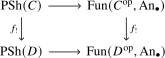 by Corollary 13.1.10
and this restricts to a commutative square of the form
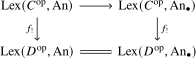 through an easy application of Theorem 18.2.8.
By definition of \(C_\bullet\), this induces a commutative square of the form
 This shows that the map
\[
\Rex(C_\bullet,D)^\simeq\to\Rex(C,D)^\simeq
\]
has a section. We will now prove that
this is an embedding. Observe first that,
by virtue of Theorem 18.2.10, the factorization of \(f\)
through \(C_\bullet\) is totally determined by the factorization of
\[
f_!\colon \Lex(C\catop,\An)\to \Lex(D\catop,\An)=\Lex(D\catop,\An_\bullet)
\]
through \(\Lex(C\catop,\An_\bullet)\).
The right adjoint of the latter is the composition of
the functor
\[
f^*\colon\Lex(D\catop,\An)=\Lex(D\catop,\An_\bullet)\to \Lex(C\catop,\An_\bullet)
\]
with the forgetful functor
\[
\Lex(C\catop,\An_\bullet)\to\Lex(C\catop,\An)\, .
\]
The uniqueness of left adjoints and the compatibility of the formation of adjoints with respect to
composition shows that the factorization through \(\Lex(C\catop,\An_\bullet)\) is unique.
This implies that the factorization of \(f\) through \(C_\bullet\) is unique.
Corollary 18.7.4. The category \(\RexCat_\bullet\) has small colimits as well as small limits.
Proof
This follows from the preceding proposition and from Corollary 14.2.5.
Proposition 18.7.5. The full embedding \(\RexCat_\bullet\hookrightarrow\RexCat\) commutes with small filtered colimits.
Proof
Let \(I\) be a small filtered category and \(i\mapsto C_i\) an \(I\)-indexed diagram
with values in \(\RexCat\). We assume that, for any object \(i\) of \(I\), the initial object \(*\) of \(C_i\)
is also a terminal object of \(C_i\). We thus have pullback squares of the form
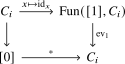 functorially in \(i\). Since the functor \(\Fun([1],-)\) commutes with small filtered colimits in \(\Cat\)
and since small filtered colimits are compatible with the formation of pullbacks in \(\Cat\),
Theorem 18.5.5 implies that the colimit \(C\) of the diagram \(i\mapsto C_i\) in \(\RexCat\)
yields a pullback square in \(\Cat\) of the form
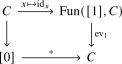 thus proving that the initial object \(*\) of \(C\) induces an equivalence \(C_{/*}\simeq C\).
This proves that \(C\) belongs to \(\RexCat_\bullet\) and implies that \(C\) is a colimit of diagram
\(i\mapsto C_i\) in \(\RexCat_\bullet\) as well.
Corollary 18.7.6. The category \(\RexCat_\bullet\) is compactly generated.
Proof
This follows from Proposition 18.3.12 and from the preceding proposition.
Proposition 18.7.7. Let \(C\) be a small category. For any pointed right exact category \(D\), there is a canonical equivalence \[ \Rex(\rex{C}_\bullet,D)\simeq\Fun(C,D)\, . \]
Proof
This is the conjunction of Theorem 18.5.2 and of Proposition 18.7.3.
Remark 18.7.8. Let \(C\) be a category with pushouts.
We denote by
\[
1^*=\ev_1\colon\Fun([1],C)\to C
\]
the functor assigning to a map of \(C\) its codomain.
The existence of an initial object \(*\) in \(C\)
amounts to the existence of a left adjoint
\[
1_!\colon C\to\Fun([1],C)
\]
of \(1^*\). Indeed, if \(*\) is initial in \(C\),
given a morphism \(u\colon x\to y\) in \(C\) and a term \(a\) in \(C\),
there is an obvious correspondence of the form
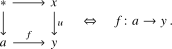 Conversely, a correspondence as above for some object \(* : C^\simeq\)
implies in the particular case \(a:=y\) and \(u:=\id_y\) that there is a unique map from \(*\) to \(y\)
for any \(y : C^\simeq\). This computation also shows that the left adjoint \(1_!\)
sends an object \(x\) to the unique map of type \(*\to x\).
The property that the initial object \(*\) of \(C\) is also terminal is equivalent to the property that
the functor \(1_!\) itself has a left adjoint
\[
1^?\colon\Fun([1],C)\to C\, .
\]
Indeed, if \(*\) is also terminal, the dual version of the preceding observation
tells us that the functor
\[
0^*=\ev_0\colon\Fun([1],C)\to C
\]
has a right adjoint
\[
0_*\colon C\to\Fun([1],C)
\]
assigning to each term \(x\) of \(C\) the unique map of type \(x\to *\).
The identity of \(*\) being both an initial object and a terminal object of \(\Fun([1],C)\),
the functor
\[
0_*\colon\Fun([1],C)\to\Fun([1],\Fun([1],C))
\]
yields the assignment
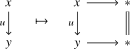 Since \(C\) has pushouts, the full embedding \(i\colon\pushout\hookrightarrow\square\)
induces an adjunction
\[
i_!\colon\Fun(\pushout,C)\rightleftarrows\Fun(\square,C)\colon i^*
\]
where \(i_!\) sends a diagram of the form \(b\leftarrow a\to c\) in \(C\) to the corresponding
pushout square
 With these conventions, the functor \(1^?\) is constructed as \(i_!\circ i^*\circ 0_*\). In other words, it sends
a map \(u\colon x\to y\) in \(C\) to
the pushout square
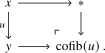 The object \(1^?(u)=\cofib(u)\), also known as the cofiber of the morphism \(u\),
is thus the evaluation at the terminal object of
\(\square=[1]\times[1]\) of \(i_!(0_*(u))\).
Conversely, if \(C\) has an initial object and if \(1_!\) has a further left adjoint \(1^?\), since \(1_!\) is fully faithful with image those maps of the form \(*\to x\), applying \(0^*\) to the unit map \[ \eta_u \colon u\to 1_!\, 1^?(u) \] yields for \(u=\id_x\) a unique map \(x\to *\) for all \(x : C^\simeq\), hence \(*\) is a terminal object of \(C\).
Definition 18.7.9. Let \(C\) be a pointed right exact category with initial object \(*\).
The suspension functor
\[
\Sigma\colon C\to C
\]
is defined by forming for each term \(x : C\) the following pushout square
 We warn the reader that,
despite what the notation suggests, although the two maps from \(*\) to \(\Sigma(x)\)
are the same (since \(*\) is initial), the commutativity constraint making this square commutative is not
the identity in general.
Proposition 18.7.10. The suspension functor \(\Sigma\colon C\to C\) is right exact.
Proof
We adopt the notation of Remark 18.7.8. The functor \(0_*\) is right exact because the functor \(x\mapsto *\) is a right exact functor and so is the identity functor \(x\mapsto x\). The cofiber functor \(1^?=\cofib\) is right exact because it is a left adjoint. Therefore, \(\Sigma=1^?\circ 0_*\) is right exact.
Proposition 18.7.11. For any right exact functor between pointed right exact categories \(f\colon C\to D\), there is a canonical identification \(\Sigma f(x) = f(\Sigma(x))\) functorially in \(x : C\).
Proof
The functor \(f\) preserves initial objects hence preserves terminal objects as well and thus commutes with the operator \(0_*\). Since it is right exact, it is compatible with the formation of pushouts, hence of cofibers.
Remark 18.7.12. We define \(\FinAn:=\rex{[0]}\), so that \[ \Ind(\FinAn)=\An\, . \] For any category \(C\) with finite colimits, we thus have \[ \Rex(\FinAn,C)=C \] by Theorem 18.5.2. If \(C\) is pointed, we even get by Proposition 18.7.7: \[ \Rex(\FinAn_\bullet,C)= C \, . \] The suspension functor \[ \Sigma\colon\FinAn_\bullet\to\FinAn_\bullet \] thus induces a functor \[ \Sigma^*\colon\Rex(\FinAn_\bullet,C)\to \Rex(\FinAn_\bullet,C)\, . \]
Lemma 18.7.13. Given a fixed pointed right exact category \(C\), under the identification \(\Rex(\FinAn_\bullet,C)=C\), the two functors \[ \Sigma^*\colon\Rex(\FinAn_\bullet,C)\to \Rex(\FinAn_\bullet,C) \quad \text{and}\quad \Sigma\colon C\to C \] agree. More generally, for any pointed right exact category \(A\), the suspension functor \[ \Sigma\colon\Rex(A,C)\to\Rex(A,C) \] agrees with the operation of pre-composition with the suspension functor \(\Sigma\colon A\to A\).
Proof
The last assertion means that, for any right exact functor \(\varphi\colon A\to C\), we have \[ \Sigma(\varphi(a)) = \varphi(\Sigma(a)) \] functorially in \(a : A\). This is precisely what the preceding proposition claims to be true.
Proposition 18.7.14. If \(A\) and \(B\) are small right exact categories, and if either \(A\) or \(B\) is pointed, then \(A\otimes B\) is pointed.
Proof
Being pointed for a small right exact category \(C\) is equivalent to the property that the canonical functor \(C\to C_\bullet\) is fully faithful. Indeed, if this is the case, then its essential image is the smallest full subcategory of \(C_\bullet\) stable under pushouts containing objects coming from \(C\), which is \(C_\bullet\) by definition. Equivalently, we deduce right away from Theorem 18.3.8 that this means that the functor \(x\mapsto x_+\) \[ \Lex(C\catop,\An)\to \Lex(C\catop,\An_\bullet) \] is an equivalence. If \(B\) is pointed, we have \begin{align*} \Lex((A\otimes B)\catop,\An) &=\Lex(A\catop,\Lex(B\catop,\An))\\ &=\Lex(A\catop,\Lex(B\catop,\An_\bullet))\\ &=\Lex((A\otimes B)\catop,\An_\bullet)\, . \end{align*} Therefore, \(A\otimes B\) is pointed whenever \(B\) is pointed. The case where \(A\) is pointed is either proved similarly or deduced from what precedes using Remark 18.6.8.
Proposition 18.7.15. Let \(A\) and \(B\) be two small categories with finite colimits. The canonical right exact functor \((-)_+\colon B\to B_\bullet\) induces a functor \[ A\otimes B\to A\otimes B_\bullet\ , \quad x\otimes y\mapsto x\otimes y_+ \] that exhibits \(A\otimes B_\bullet\) as the free pointed right exact category associated to \(A\otimes B\) and thus induces a canonical equivalence \[ (A\otimes B)_\bullet\simeq A\otimes B_\bullet\, . \]
Proof
We have \begin{align*} \Rex(A\otimes B,(A\otimes B)_\bullet) &=\Rex(A,\Rex(B,(A\otimes B)_\bullet))\\ &=\Rex(A,\Rex(B_\bullet,(A\otimes B)_\bullet))\\ &=\Rex(A\otimes B_\bullet,(A\otimes B)_\bullet)\, . \end{align*} There is thus a unique right exact functor \(u\colon A\otimes B_\bullet\to (A\otimes B)_\bullet\) sending \(x\otimes y_+\) to \((x\otimes y)_+\) for all \(x : A\) and \(y : B\). Similarly, the universal property of \((A\otimes B)_\bullet\) and Proposition 18.7.14 provide a functor \(v\colon (A\otimes B)_\bullet\to A\otimes B_\bullet\) uniquely determined by the property that it sends \((x\otimes y)_+\) to \(x\otimes y_+\) for all \(x : A\) and \(y : B\). Therefore \(u\) and \(v\) must be inverse to each other.
Remark 18.7.16. Given a pointed right exact category \(C\), the suspension functor \[ \Sigma\colon C\to C \] agrees with the functor \[ \Sigma\otimes\id_C\colon \FinAn_\bullet\otimes C\to \FinAn_\bullet\otimes C \] induced by the suspension \(\Sigma\colon\FinAn_\bullet\to\FinAn_\bullet\) up to the canonical equivalences \[ C\simeq\FinAn\otimes C\simeq\FinAn_\bullet\otimes C\, . \] Indeed, for \(S^0:= *_+\) and \(S^1:=\Sigma(S^0)\), we see with Proposition 18.7.11 that \[ S^1\otimes x=S^0\otimes\Sigma(x) \] for all \(x : C\). Since \(\Rex(\FinAn_\bullet,C)=C\) through evaluation at \(S^0\), this proves the claim. This identification is useful to prove the following proposition.
Proposition 18.7.17. The suspension functor can be promoted to an endomorphism of the identity of \(\RexCat_\bullet\)
in the category \(\Fun(\RexCat_\bullet,\RexCat_\bullet)\). In other words, we get a
commutativity constraint
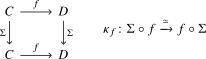 for any right exact functor \(f\), functorially in \(f\).
Proof
There is a functorial identification \[ a_C\colon\FinAn_\bullet\otimes C\iso C \] and the suspension \(\Sigma\colon\FinAn_\bullet\to\FinAn_\bullet\). We will see that the assignment \[ C\mapsto a_C\circ \, \Sigma\otimes\id_C\circ \, a_C^{-1} \] provides a natural transformation with the expected properties.
Exercise 18.7.18. Prove that, for any finite poset \(P\), one has \[ \Fun(P\catop,\FinAn_\bullet)=\rex{P}_\bullet\, . \] Deduce that, for any \(C\) pointed and right exact, the suspension functor \[ \Sigma\colon\Fun(P,C)\to\Fun(P,C) \] is induced through the identification above by pre-composition with the suspension functor \[ \Sigma\colon\Fun(P\catop,\FinAn_\bullet)\to\Fun(P\catop,\FinAn_\bullet)\, . \]