Adjunctions play a crucial role in category theory by encoding pairs of functors \(l\colon C \to D\) and \(r\colon D \to C\) equipped with a natural equivalence of hom animae \(D(lx,y) \simeq C(x,ry)\). Since we do not yet have the hom functor available, we introduce adjunctions instead through their equivalent formulation in terms of units and counits. We then study Bousfield localizations, initial and terminal objects, and adjunctions between categories over a base.
Definition 4.4.1 (Adjunction). Consider two functors \(l\colon C \to D\) and \(r\colon D \to C\). An adjunction \(l \dashv r\) consists of natural transformations \(\eta\colon \id_C \to rl\) and \(\epsilon\colon lr \to \id_D\) satisfying the triangle identities:
 We call \(\eta\) the unit of the adjunction and \(\epsilon\) the counit. We often write \((l \dashv r) \colon C \rightleftarrows D\) to indicate the data \((l,r,\eta,\epsilon)\) of an adjunction.
Warning 4.4.2. To obtain the correct category of adjunctions, Definition 4.4.1 needs to be modified as follows: an adjunction \(l \dashv r\) consists of a natural transformation \(\eta\colon \id_C \to rl\) and two natural transformations \(\epsilon,\epsilon'\colon lr \to \id_D\) satisfying the triangle identities:
 One may then deduce a posteriori that the counits \(\epsilon\) and \(\epsilon'\) are equivalent to each other, much like the left and right inverses of an equivalence are canonically equivalent.
Since we will not have much interest in the category of adjunctions in this book, we will keep working with the somewhat simpler and more familiar definition of an adjunction given in Definition 4.4.1.
Proposition 4.4.3. Let \((l \dashv r)\colon C \rightleftarrows D\) and \((l' \dashv r')\colon D \rightleftarrows E\) be adjunctions. Then the composite functors \(l'l\colon C \to E\) and \(rr'\colon E \to C\) constitute an adjunction \((l'l \dashv rr')\colon C \rightleftarrows E\).
Proof
The corresponding unit and counit are given as the composites \[ \id_C \xrightarrow{\eta} rl \xrightarrow{r\eta'l} rr'l'l \qquadtext{ and } l'lrr' \xrightarrow{l'\epsilon r'} l'r' \xrightarrow{\epsilon'} \id_E. \] We leave the verification of the triangle identity to the reader, see Exercise 4.9.1
Proposition 4.4.4. Let \((l \dashv r)\colon C \leftrightarrows D\) be an adjunction. Then for every category \(E\) we obtain adjunctions \[ l_*\colon \Fun(E,C) \rightleftarrows \Fun(E,D)\noloc r_* \qquadtext{ and } r^*\colon \Fun(D,E) \rightleftarrows \Fun(C,E) \noloc l^*. \]
Proof
We construct the first adjunction and leave the second adjunction to the reader. To construct the unit \(\eta_*\colon \id_{\Fun(E,C)} \to r_*l_*\), we may by currying equivalently produce a transformation between the two curried functors \(E \times \Fun(E,C) \to C\), which we do by whiskering the transformation \(\eta\colon \id_C \to rl\) with the evaluation functor \(\ev\colon E \times \Fun(E,C) \to C\). The counit \(\epsilon_*\colon l_*r_* \to \id_{\Fun(E,D)}\) is constructed similarly. The triangle identities for \(\eta_*\) and \(\epsilon_*\) follow directly from the triangle identities of \(\eta\) and \(\epsilon\) after whiskering.
Proposition 4.4.5. Adjoints are unique: if \((l \dashv r) \colon C \rightleftarrows D\) and \((l \dashv r')\colon C \rightleftarrows D\) are adjunctions, there is a preferred identification \(r = r'\).
Proof
Consider the following two composites: \[ r \xrightarrow{\eta' r} r'lr \xrightarrow{r' \epsilon} r' \qquadtext{ and } r' \xrightarrow{\eta r'} rlr' \xrightarrow{r \epsilon'} r. \] These two maps can be shown to be inverse to each other, finishing the proof. We leave the details to the reader, see Exercise 4.9.2
Proposition 4.4.6. Let \(f\colon C \to D\) be an equivalence with inverse \(g\colon D \to C\). Then there exists an adjunction \(f \dashv g\) between \(f\) and \(g\).
Proof
Choose an identification \(\eta:\id_C = gf\). By Lemma 1.3.10, prewhiskering with \(f\) induces an equivalence of animae of identifications \[ (fg = \id_D)\longrightarrow(fgf = f), \qquad \varepsilon\longmapsto\varepsilon f. \] We may therefore choose an identification \(\varepsilon:fg = \id_D\) together with an identification \(\varepsilon f = (f\eta)^{-1}\). Thus \[ (\varepsilon f)\circ(f\eta) = \id_f, \] which is the first triangle identity.
By naturality (Lemma 2.2.10) we obtain an identification \[ (gf\eta)\circ\eta = (\eta gf)\circ\eta. \] Cancelling the invertible transformation \(\eta\) gives \(gf\eta = \eta gf\), and we compute \begin{align*} \bigl((g\varepsilon)\circ(\eta g)\bigr)f &= g(\varepsilon f)\circ(\eta gf)\\ &= g(\varepsilon f)\circ(gf\eta)\\ &= g\bigl((\varepsilon f)\circ(f\eta)\bigr) = \id_{gf} = (\id_g)f. \end{align*} Since prewhiskering with \(f\) is an equivalence on animae of identifications, this identification lifts to \((g\varepsilon)\circ(\eta g) = \id_g\). This is the second triangle identity, proving \(f\dashv g\).
Given an adjunction \(l \vdash r\), we obtain for each absolute object \(x \in C\) and \(y \in D\) an equivalence \[ D(lx,y) \iso C(x,ry) \] by sending a morphism \(f\colon lx \to y\) to the composite \(x \xrightarrow{\eta_x} rlx \xrightarrow{r(f)} ry\). If one remembers that this equivalence is ‘natural in \(x\) and \(y\)’, it in fact provides an alternative encoding of adjunctions. Since we do not yet have hom functors available at this point, we cannot use this formulation yet. The following proposition is a variant of this idea, phrased in terms of the directed pullbacks \(C \vectimes{l} D\) and \(C \vectimes{r} D\) over \(C \times D\), whose fibers over \((x,y)\) are \(D(lx,y)\) and \(C(x,ry)\), respectively.
Proposition 4.4.7. Let \(l\colon C \to D\) and \(r\colon D \to C\) be functors. Then the following two conditions are equivalent:
(1) There exist a unit \(\eta\colon \id_C \to rl\) and counit \(\epsilon\colon lr \to \id_D\) which exhibit \(r\) as a right adjoint of \(l\);
(2) There exists an equivalence \(\alpha\colon C \vectimes{l} D \iso C \vectimes{r} D\) over \(C \times D\).
Proof
To prove that (1) implies (2), let \(\eta\colon\id_C\to rl\) and \(\varepsilon\colon lr\to\id_D\) exhibit an adjunction. On the universal term \((x,y,u)\) of \(C\vectimes{l}D\), we have a morphism \(u\colon lx\to y\). Applying \(r\) and composing with \(\eta_x\) gives a morphism \(r(u)\circ\eta_x\colon x\to ry\). By Construction 2.2.3, this defines a functor to \(\Ar(C)\) with the indicated source and target identifications. The defining pullback therefore supplies a functor \[ \alpha\colon C\vectimes{l}D\longrightarrow C\vectimes{r}D, \qquad \alpha_{x,y}(u)=r(u)\circ\eta_x, \] over \(C\times D\). Similarly, applying \(l\) to the universal morphism \(v\colon x\to ry\) and composing with \(\varepsilon_y\) gives a functor \[ \beta\colon C\vectimes{r}D\longrightarrow C\vectimes{l}D, \qquad \beta_{x,y}(v)=\varepsilon_y\circ l(v), \] over \(C\times D\).
On the respective directed pullbacks, we compute \begin{align*} \beta_{x,y}(\alpha_{x,y}(u)) &= \varepsilon_y\circ lr(u)\circ l\eta_x = u\circ\varepsilon_{lx}\circ l\eta_x = u,\\ \alpha_{x,y}(\beta_{x,y}(v)) &= r\varepsilon_y\circ rl(v)\circ\eta_x = r\varepsilon_y\circ\eta_{ry}\circ v = v. \end{align*} Here we use preservation of composition by functors, naturality of \(\varepsilon\) and \(\eta\), and the triangle identities. These identifications fix the displayed sources and targets: preservation of composition, associativity, and unitality do so by Lemma 2.2.5, Proposition 2.2.7 and Lemma 2.2.6, while the naturality identifications lie in the hom animae specified by Lemma 2.2.10. Thus the two calculations give identifications in \(D(lx,y)\) and \(C(x,ry)\), respectively, on the respective total categories. Together with the unchanged projections \(x\) and \(y\), the pullback property gives identifications \(\beta\alpha = \id\) and \(\alpha\beta = \id\) over \(C\times D\). This proves (2).
Conversely, let \(\alpha\) be an equivalence as in (2), and choose an inverse \(\beta\) with inverse identifications over \(C\times D\). The identity morphisms define functors \[ C\longrightarrow C\vectimes{l}D,\quad x\longmapsto(x,lx,\id_{lx}), \qquad D\longrightarrow C\vectimes{r}D,\quad y\longmapsto(ry,y,\id_{ry}). \] Composing with \(\alpha\) and \(\beta\), respectively, and then projecting to \(\Ar(C)\) and \(\Ar(D)\) gives natural transformations \begin{align*} \eta\colon\id_C\to rl, &\qquad \eta_x=\alpha_{x,lx}(\id_{lx}),\\ \varepsilon\colon lr\to\id_D, &\qquad \varepsilon_y=\beta_{ry,y}(\id_{ry}). \end{align*} Their source and target identifications are supplied by the fact that \(\alpha\) and \(\beta\) are functors over \(C\times D\).
For the converse we use the theory of cocartesian transport developed later in this chapter. To verify the triangle identities, regard \(\alpha\) as an equivalence over \(D\) between the two cocartesian directed-pullback projections. It preserves cocartesian transport by Corollary 4.7.5. Similarly, \(\beta\), regarded over \(C\), preserves the cartesian transport of the two source projections. The transport formulas for slices and their pullbacks give \begin{align*} \alpha_{x,y'}(b\circ u)&=r(b)\circ\alpha_{x,y}(u),\\ \beta_{x',y}(v\circ a)&=\beta_{x,y}(v)\circ l(a), \end{align*} for \(a\colon x'\to x\), \(b\colon y\to y'\), \(u\colon lx\to y\), and \(v\colon x\to ry\). These are identifications of the actual transport functors on the directed pullbacks. They are compatible with the specified source and target identifications.
Applying these compatibilities to identity morphisms and using unitality, over \(D\) and \(C\), respectively, gives \begin{align*} r\varepsilon_y\circ\eta_{ry} &= \alpha_{ry,y}(\varepsilon_y) =\alpha_{ry,y}\bigl(\beta_{ry,y}(\id_{ry})\bigr) = \id_{ry},\\ \varepsilon_{lx}\circ l\eta_x &= \beta_{x,lx}(\eta_x) =\beta_{x,lx}\bigl(\alpha_{x,lx}(\id_{lx})\bigr) = \id_{lx}. \end{align*} The last identifications use the inverse identifications of \(\alpha\) and \(\beta\) over \(C\times D\). Consequently, these calculations take place in \(C(ry,ry)\) and \(D(lx,lx)\) with their prescribed sources and targets. Currying gives the two triangle identities as identifications of natural transformations, proving (1).
4.4.1 Bousfield localizations
Bousfield localizations arise from adjunctions whose unit or counit is invertible. We establish their basic closure properties, relate them to localizations, and give a criterion in terms of an idempotent functor.
Definition 4.4.8 (Left/right adjoint section). Let \(f\colon C \to D\) be a functor. A left adjoint section of \(f\) is a left adjoint \(s\colon D \to C\) such that the unit transformation \(\eta\colon \id_D \to fs\) is a natural isomorphism. Dually, a right adjoint section of \(f\) is a right adjoint \(s\colon D \to C\) such that the counit transformation \(\epsilon\colon fs \to \id_D\) is a natural isomorphism.
In other words, \(f\) admits a left adjoint section if and only if it admits a section \(s\colon D \to C\) (i.e. a functor satisfying \(fs = \id_D)\) which comes equipped with a natural transformation \(\epsilon \colon sf \to \id_C\) of functors \(C \to C\) satisfying the following two conditions:
• The map \(\epsilon\) is a transformation living over \(D\): the induced map \(f\epsilon \colon f = fsf \to f\) is identified with the identity transformation.
• The map \(\epsilon\) restricts to the identity on \(D\): the map \(\epsilon s\colon s = sfs \to s\) is identified with the identity transformation.
Definition 4.4.9 (Left/right Bousfield localization). A functor \(f\colon C \to D\) is called a left Bousfield localization if it admits a right adjoint section. We call \(f\) a right Bousfield localization if it admits a left adjoint section.
We will see in Proposition 6.4.10 that a left/right adjoint section \(s\colon D \to C\) of a functor \(f\colon C \to D\) is automatically a full subcategory. We may then think of \(f\) as reflecting the category \(C\) into this subcategory \(D\).
Lemma 4.4.10. Every equivalence \(C \iso D\) is both a left and a right Bousfield localization.
Proof
This is immediate from Proposition 4.4.6.
Lemma 4.4.11. For a category \(C\), the target functor \(\ev_1\colon \Fun([1],C) \to C\) is a left Bousfield localization with right adjoint section given by \[ s = p_{[1]}^*\colon C \to \Fun([1],C). \] Dually, the source functor \(\ev_0\colon \Fun([1],C) \to C\) is a right Bousfield localization.
Proof
We prove the claim for \(\ev_1\); the claim for \(\ev_0\) is dual. Consider the following functor: \[ \Fun([1],C) \times [1] \to \Fun([1],C); \qquad (f,t) \mapsto (s \mapsto f(\max(t,s))). \] Using Lemma 2.1.12, we see that \(f(\max(0,y)) = f(y)\) and \(f(\max(1,y)) = f(1)\), so that this assignment defines a natural transformation \[ \eta\colon \id_{\Fun([1],C)} \to s \ev_1 \] of functors \(\Fun([1],C) \to \Fun([1],C)\). It also follows from Lemma 2.1.12 that:
• The evaluation of \(\eta\) at \(1\) gives the identity of \(\ev_1\);
• Applying \(\eta\) to \(s(c)\) gives the identity of \(s(c)\).
This shows that \(\eta\) exhibits \(s\) as a right adjoint section of \(\ev_1\), finishing the proof.
We can relax the condition on the transformation \(\epsilon\) as follows:
Proposition 4.4.12. Let \(f\colon C \to D\) be a functor. Assume that there exists a section \(s\colon D \to C\) of \(f\) and a natural transformation \(\epsilon\colon sf \to \id_C\) over \(D\) such that the transformation \(\epsilon s\colon s = sfs \to s\) is a natural isomorphism. Then \(s\) is a left adjoint section of \(f\).
The analogous statement for right adjoint sections also holds.
Proof
Let \((\epsilon s)^{-1}\colon s \to s\) be an inverse of \(\epsilon s\colon s \to s\). We define a new transformation \(\epsilon'\colon sf \to \id_C\) as the following composite: \[ sf \xrightarrow{(\epsilon s)^{-1}f} sf \xrightarrow{\epsilon} \id_C. \] This is again a transformation over \(D\), and it satisfies \[ \epsilon' s = (\epsilon s) \circ ((\epsilon s)^{-1}fs) = (\epsilon s) \circ (\epsilon s)^{-1} = \id_s. \] This shows that the map \(\epsilon'\colon sf \to \id_C\) exhibits \(s\) as a left adjoint section of \(f\).
Left and right Bousfield localizations are closed under a variety of operations.
Proposition 4.4.13 (Composition). Left (resp. right) Bousfield localizations are closed under composition.
Proof
By Proposition 4.4.3 the composite functors form again an adjunction, and it is immediate from the descriptions of the unit and counit in the proof that the composite is again a left/right Bousfield localization.
Proposition 4.4.14 (Functor categories). Let \(f\colon C \to D\) be a left (resp. right) Bousfield localization. Then also the functor \(f_*\colon \Fun(A,C) \to \Fun(A,D)\) is a left (resp. right) Bousfield localization for any category \(A\).
Proof
This is immediate from Proposition 4.4.4.
Proposition 4.4.15 (Base change). Left (resp. right) Bousfield localizations are stable under base change.
Proof
We prove the claim for right Bousfield localizations; the claim for left Bousfield localizations is dual. Consider a pullback square
 where \(f\) is a right Bousfield localization. Let \((s,\epsilon)\) be a left adjoint section of \(f\). By the universal property of the pullback, we obtain a section \(s'\colon D' \to C'\) of \(f'\) satisfying \(us' = sv\):
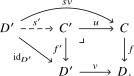 Similarly, we define the map \(\epsilon'\colon C' \times [1] \to C'\) over \(D'\) via the following commutative diagram:
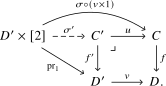
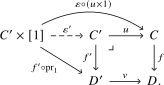 Note that \(\epsilon'\) is indeed a transformation from \(s'f'\) to \(\id_{C'}\) over \(D'\). Finally, we construct the desired commutative diagram \(\sigma'\colon D' \times [2] \to C'\) via the following commutative diagram:
Proposition 4.4.16. Let \(f\colon C \to D\) be a left (resp. right) Bousfield localization. Then \(f\) is a localization, in the sense of Definition 3.3.6.
Proof
Let \(s\colon D \to C\) be a left adjoint section of \(f\), with identification \(\eta: \id_D = f s\) and counit \(\epsilon\colon s f \to \id_C\). For any category \(E\), the induced functor
\[
f^*\colon \Fun(D,E) \to \Fun(C,E)
\]
is a left adjoint section of \(s^*\colon \Fun(C,E) \to \Fun(D,E)\), see Proposition 4.4.4. Let \(W \hookrightarrow \Map([1],C)\) denote the collection of morphisms in \(C\) that are sent to isomorphisms in \(D\) under \(f\), i.e. 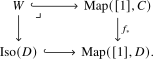 Since the map \(f(\epsilon_x) \colon f(s(f(x))) \to f(x)\) is an isomorphism by the triangle identity, it follows that the map \(\epsilon_x\colon s(f(x)) \to x\) lies in \(W\) for any object \(x\) of \(C\). In particular, for any functor \(F\colon C \to E\) in \(\Fun^W(C,E)\), the counit of the adjunction \(f^* \dashv s^*\) is a natural isomorphism: \(f^* s^*F \iso F\). It follows that this adjunction restricts to an adjunction
\[
f^*\colon \Fun(D,E) \rightleftarrows \Fun^W(C,E) \noloc s^*
\]
in which both the unit and counit are equivalences. We conclude that the induced functor
\[
f^*\colon \Fun(D,E) \to \Fun^W(C,E)
\]
is an equivalence, showing that \(f\) exhibits \(D\) as a localization of \(C\) at \(W\) as desired.
Proposition 4.4.17. Left (respectively right) adjoint sections are stable under pushout.
Proof
We prove the claim for right adjoint sections; the other claim is dual.
Consider a pushout square
 where \((s,\epsilon\colon \id_C\to sf)\)
is a right adjoint section of \(f\colon C\to D\).
By the universal property of the pushout
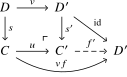 we obtain a map \(f'\) with \(f's'=\id_{D'}\).
Similarly, we define the map \(\epsilon'\colon C'\times [1]\to C'\) over \(D'\)
via the following commutative diagram (over \(D'\))
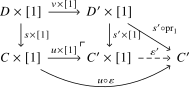 using that \(-\times [1]\) preserves pushouts.
At \(0,1\in [1]\) this diagram restricts to
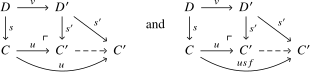 respectively,
which have (unique) solutions \(\id_{C'}\) and \(s'f'\)
(using the given identifications \(s'f'u=s'vf=usf\));
this shows that \(\epsilon'\) is indeed a transformation
\(\id_{C'}\to s'f'\) over \(D'\).
Finally, \(\epsilon'\circ (s'\times [1])=s'\circ \pr_1\) by construction.
Thus \((s',\epsilon')\) is a right adjoint section of \(f'\).
Proposition 4.4.18 (Idempotent localization criterion). Let \(L\colon C \to C\) be a functor equipped with a natural transformation \(\eta\colon \id_C \Rightarrow L\). Assume that both \[ \eta_{Lx}\colon Lx \to LLx \qquad\text{and}\qquad L\eta_x\colon Lx \to LLx \] are isomorphisms for every object \(x\) of \(C\). Let \(D\subseteq C\) be the full subcategory spanned by those objects \(z\) for which \(\eta_z\) is an isomorphism. Then \(L\) factors through a functor \(l\colon C\to D\) which is left adjoint to the inclusion \(i\colon D\hookrightarrow C\), with unit \(\eta\). In particular, \(l\) is a left Bousfield localization.
Proof
We first construct \(D\) by the pullback
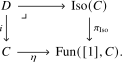 Here the bottom functor is the one encoding the transformation \(\eta\).
By Propositions 3.4.4 and 3.4.5, the right-hand
functor is a full subcategory. Its pullback therefore exhibits \(D\) as the
claimed full subcategory of \(C\). Since every \(\eta_{Lx}\) is invertible,
we may use the characterization of Corollary 3.2.8
to get a factorization \(l \colon C \to D\) of \(L\) through \(D\). Note that every \(z:D\) is isomorphic to
\(Lz\) via \(\eta_z\), so \(D\) contains precisely the objects in the essential image of \(L\).
By the pointwise criterian for natural isomorphisms (Proposition 3.4.6), the transformations \(\eta L\) and \(L\eta\) are invertible. We claim that \(\eta L = L\eta\). Applying Lemma 2.2.10 to \(\eta\) twice gives \[ (L\eta)\circ\eta = (\eta L)\circ\eta. \] Whiskering with \(L\) on the left gives \((LL\eta)\circ(L\eta) = (L\eta L)\circ(L\eta)\), and since \(L\eta\) is invertible we obtain \(L^2\eta = L\eta L\). Similarly, naturality of \(\eta L\) gives \[ (L\eta L)\circ(\eta L) = (\eta L^2)\circ(\eta L), \] and since \(\eta L\) is invertible we deduce \(L\eta L = \eta L^2\). Finally, naturality applied to \(L\eta\) gives \[ (L^2\eta)\circ(\eta L) = (\eta L^2)\circ(L\eta). \] Plugging in the preceding two identifications and cancelling the invertible transformation \(\eta L^2\) then proves the claim.
We now establish the adjunction \(l \vdash i\). Consider the restricted transformation \(\eta i\colon i\to ili\), which is invertible by construction. By the universal property of the subcategory inclusion \(i\colon D \hookrightarrow C\), it lifts to an invertible transformation \(\id_D\to li\), and we let \(\varepsilon\colon li\to\id_D\) be its inverse. Then we have \[ (i\varepsilon)\circ(\eta i) = \id_i \] by construction. For the other triangle identity \((\varepsilon l)\circ(l\eta) = \id_l\), we may again check this after applying \(i\). But there we have \[ (i\varepsilon l)\circ(il\eta) = (\eta L)^{-1}\circ(L\eta) = \id_L. \] We conclude that we have an adjunction \(l\dashv i\), with unit \(\eta\) and invertible counit \(\varepsilon\), as required.
4.4.2 Initial and terminal objects
Initial and terminal objects are the special cases of left and right adjoint sections for the functor \(C\to *\). We use this description to characterize these objects and give basic examples.
Lemma 4.4.19. Let \(C\) be a category and let \(x\) be an absolute object of \(C\). Then the following conditions are equivalent:
(1) The object \(x\) is initial in the sense of Definition 2.1.9: the forgetful functor \(C_{x/} \to C\) is an equivalence;
(2) The object \(x\) defines a left adjoint section \(x\colon * \to C\) of the functor \(p_C\colon C \to *\);
(3) There exists a transformation \(\epsilon\colon \const_x \to \id_C\) and an identification \(\epsilon_x = \id_x\) of functors \(* \to C\). Here \(\const_x\) is defined as the composite \(C \xrightarrow{p_C} * \xrightarrow{x} C\).
(4) There exists a transformation \(\epsilon\colon \const_x \to \id_C\) such that the map \(\epsilon_x\colon x \to x\) is an isomorphism in \(C\).
The dual statement for terminal objects is also valid.
Proof
Let \(q\colon C_{x/}\to C\) be the slice projection. If (1) holds, an inverse of \(q\) gives a transformation \(\epsilon\colon\const_x\to\id_C\). The fiber of \(q\) over \(x\) is contractible and contains \(\id_x\), so \(\epsilon_x=\id_x\). This proves (3). Conversely, a transformation as in (3) defines a section \(j\colon C\to C_{x/}\) of \(q\). Naturality at the universal arrow \(u\colon x\to y\) of \(C_{x/}\) gives \(\epsilon_y=u\epsilon_x=u\), with the specified endpoints. These identifications define \(jq=\id_{C_{x/}}\) over \(C\), so \(q\) is an equivalence. Thus (1) and (3) are equivalent. To see that (2) is equivalent to (3), note that there is only a single functor \(C \times [1] \to *\), and hence the unit transformation \(\eta\colon \id_{*} \to p_C\circ x\) is unique. One of the two triangle identities is automatic, and the remaining triangle identity amounts to condition (3). The equivalence between (3) and (4) is a special case of Proposition 4.4.12.
Remark 4.4.20. Let \(0\) be an initial object of \(C\). Point (2) says that the functor \(C_{0/} \to C\) is an equivalence, and in particular for every \(y \in C\) the fiber \(C(0,y)\) of this map over \(y\) is contractible. Informally, this says that for every \(y\) there exists a unique morphism \(0 \to y\) in \(C\).
The converse will be treated later, using functoriality of universals.
Lemma 4.4.21. Let \(f\colon C \to D\) be a right Bousfield localization with left adjoint section \(s\colon D \to C\). For every object \(d\) of \(D\), the object \(s(d) \in C_d\) is an initial object of the fiber \(C_d := \{d\} \times_D C\).
The dual statement for left Bousfield localizations and terminal objects also holds.
Proof
It follows from Proposition 4.4.15 that the base change \(f\vert_{C_d}\colon C_d \to \{d\}\) of \(f\) along \(\{d\} \to D\) is again a right Bousfield localization with left adjoint section given by the restriction \(s\vert_{\{d\}}\colon \{d\} \to C_d\). By definition this means that \(s(d)\) is an initial object of \(C_d\).
We will now provide some basic examples of initial and terminal objects. The most important example will be the walking morphism:
Lemma 4.4.22. The category \([1]\) has both an initial object \(0: [1]\) and a terminal object \(1: [1]\).
Proof
This is true as Axiom C.2.
This lets us compute all the hom animae of \([1]\):
Corollary 4.4.23. There are equivalences \[ \Hom_{[1]}(0,0) \simeq *, \qquad \Hom_{[1]}(0,1) \simeq * \qquadtext{ and } \Hom_{[1]}(1,1) \simeq *. \]
Proof
This is immediate from Lemma 4.4.22.
Corollary 4.4.24. There is an equivalence \(\Hom_{[1]}(1,0) \simeq \emptyset\).
Proof
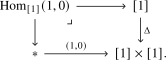
We first show that every morphism \(f\colon 1 \to 0\) in \([1]\) is an isomorphism with inverse the canonical morphism \(\can\colon 0 \to 1\). Indeed, by Corollary 4.4.23 there are unique identifications \(f \circ \can = \id_0\) and \(\can \circ f = \id_1\), so that \(\can\) provides both a left and a right inverse to \(f\). Since \([1] \simeq \Iso([1]) \hookrightarrow \Fun([1],[1])\) is an embedding by Lemma 2.3.3, we deduce that \(\Hom_{[1]}(1,0)\) sits in a pullback square as follows:
 Furthermore, since \([1]^{\simeq} \hookrightarrow [1]\) is an embedding Corollary 2.5.3, the right-hand square in the following commutative diagram is a pullback square, and hence by the pasting law so must be the left-hand square:
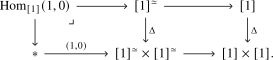 But since \([1]^{\simeq} \simeq \{0,1\}\) is a disjoint union of two points, we see that
\[
[1]^{\simeq} \times [1]^{\simeq} \simeq \{(0,0), (0,1), (1,0), (1,1)\}
\]
is a disjoint union of four points, and the diagonal map corresponds to the inclusion
\[
\{(0,0), (1,1)\} \hookrightarrow \{(0,0), (0,1), (1,0), (1,1)\}\, .
\]
It thus follows from the universality of disjoint unions, Axiom B.5', that the pullback over the point \((1,0)\) is empty.
Lemma 4.4.25. For a term \(x\) of a category \(C\), the slice category \(C_{/x}\) admits a terminal object \((x, \id_x\colon x \to x)\). Similarly, \(C_{x/}\) admits an initial object \((x,\id_x\colon x \to x)\).
Proof
We showed in Lemma 4.4.11 that the evaluation map \(\ev_1\colon \Fun([1],C) \to C\) admits a right adjoint section given by \(p_{[1]}^*\colon C \to \Fun([1],C)\). Since \(C_{/x}\) is the fiber over \(x\) of this map, the claim follows from the dual statement in Lemma 4.4.21.
If one already knows the existence of an initial object \(x\), then other initial objects are particularly easy to recognize:
Exercise 4.4.26. Let \(x\) and \(y\) be objects in a category \(C\) and assume that \(x\) is an initial object. Then \(y\) is an initial object if and only if the canonical map \(x \to y\) from (the dual of) Remark 4.4.20 is an isomorphism.
The dual statement for terminal objects also holds.
Corollary 4.4.27. Let \(C'\subseteq C\) be the full subcategory spanned by the terminal objects. Then \(C'\) is an anima and \(C'\to *\) is an embedding. In particular, if \(C\) admits a terminal object, \(C'\) is contractible. The dual statement holds for initial objects.
Proof
For objects \(x,y\) of \(C'\), fullness and the dual of Remark 4.4.20 give \[ C'(x,y)\simeq C(x,y)\simeq *. \] Every morphism \(x\to y\) is therefore invertible: the unique morphism \(y\to x\) is an inverse, since both endomorphism animae are contractible. Thus \(C'\) is a groupoid, hence an anima by the groupoid recognition axiom. By Corollary 2.3.5, the anima \((x=y)\) is contractible as well. Applying this in the anima context \((x,y):C'\times C'\) identifies the two projections to \(C'\), so the first projection is inverse to the diagonal \(C'\to C'\times C'\). This proves that \(C'\to *\) is an embedding. If \(C\) admits a terminal object, this embedding has a section and is therefore an equivalence by Lemma 1.6.24.
4.4.3 Relative adjunctions
A relative adjunction is an ordinary adjunction between categories over a fixed base whose unit and counit are natural transformations over that base.
Recall from Definition 1.9.2 that \(\Fun_S(C,D)\) denotes the category of functors from \(C\) to \(D\) over \(S\).
Definition 4.4.28 (Relative adjunction). Let \(p\colon C\to S\) and \(q\colon D\to S\) be functors, and let \(L\colon C\to D\) be a functor over \(S\). A right adjoint to \(L\) relative to \(S\) consists of a functor \(R\colon D\to C\) over \(S\) and a counit \[ \varepsilon\colon LR\longrightarrow\id_D \] in \(\Fun_S(D,D)\) which exhibits the underlying functor \(R\colon D\to C\) as a right adjoint to the underlying functor \(L\colon C\to D\). We then call \(L\dashv R\) an adjunction relative to \(S\).
Thus a relative counit is a counit whose components lie over identity morphisms in \(S\). Equivalently, one may impose this condition on the unit.
Proposition 4.4.29 (Unit formulation of relative adjunctions). Let \(C\) and \(D\) be categories over \(S\), and let \(L\colon C\to D\) and \(R\colon D\to C\) be functors over \(S\). The following data are equivalent:
(1) A counit \(\varepsilon\colon LR\to\id_D\) in \(\Fun_S(D,D)\) which exhibits \(R\) as a right adjoint to \(L\);
(2) A unit \(\eta\colon\id_C\to RL\) in \(\Fun_S(C,C)\) which exhibits \(L\) as a left adjoint to \(R\).
Proof
Suppose first that the counit \(\varepsilon\) lies over \(S\), and let \(\eta\) be the unit of the underlying adjunction. Apply \(q\) to the triangle identity \[ (\varepsilon L)(L\eta)=\id_L. \] After using the structure identifications \(qL = p\) and \(pR = q\), the first factor lies over an identity morphism. It follows that \(p\eta\) is the identity transformation of \(p\), so \(\eta\) lies over \(S\). Conversely, if \(\eta\) lies over \(S\), applying \(p\) to the other triangle identity \[ (R\varepsilon)(\eta R)=\id_R \] shows that \(\varepsilon\) lies over \(S\).
Proposition 4.4.30 (Relative adjunctions on functor categories). Let \(L\colon C\rightleftarrows D\noloc R\) be an adjunction relative to \(S\). For every functor \(E\to S\), postcomposition induces an adjunction \[ L_*\colon\Fun_S(E,C) \rightleftarrows \Fun_S(E,D)\noloc R_*. \]
Proof
Whiskering the relative unit and counit with functors out of \(E\) gives a unit and counit over \(S\). Their triangle identities are inherited from those of \(L\dashv R\).
Proposition 4.4.31 (Composition and base change). Relative adjunctions compose and are preserved by base change. More precisely:
(1) If \(L\colon C\rightleftarrows D\noloc R\) and \(L'\colon D\rightleftarrows E\noloc R'\) are adjunctions relative to \(S\), then \(L'L\dashv RR'\) is an adjunction relative to \(S\);
(2) If \(L\dashv R\) is an adjunction relative to \(S\) and \(T\to S\) is any functor, then the induced functors between the base changes to \(T\) form an adjunction relative to \(T\).
Proof
The usual formulas for the unit and counit of a composite adjunction use only whiskering and composition. They therefore remain transformations over \(S\). For the second assertion, pull back the relative unit, counit, and their triangle identifications along \(T\to S\).