Lemma 17.2.1. Let \(I\) be a small filtered category any \(i\mapsto C_i\) an \(I\)-indexed functor with values in \(\Cat\) whose colimit will be denoted by \(C\). We consider a functor \(u\colon B\to C\) and define \(B_i=B\times_C C_i\) for each \(i\colon I\). Then the canonical functor \[ \underset{i\colon I}{\colim}\, B_i\to B \] is an equivalence of categories.
Proof
Since the nerve functor preserves finite limits as well as small filtered colimits, this follows from the fact that colimits are universal in \(\PSh(\Delta)\), which follows itself from the analogous property in \(\An\).
Lemma 17.2.2. Let \(F\hookrightarrow\Cat^\simeq\) be a small family of categories. We consider a locally small category with small colimits and a small full subcategory \(A\) of \(C\). The smallest full subcategory of \(C\) containing \(A\) and stable under colimits indexed by any \(I\colon F\) exists and is small as well.
Proof
It suffices to prove that there exists at least
one full subcategory of \(C\) that is small, contains \(A\), and is stable under any
\(I\)-indexed colimit for any \(I\colon F\).
It suffices to prove this after replacing \(F\) by any larger small family of categories.
Therefore, we may assume that, for any \(B\colon F\) and any full embedding \(A\hookrightarrow B\),
the category \(A\) is a term of \(F\) as well. We may also assume that \([0]\colon F\).
We introduce the following operator on the collection of all full subcategories of \(C\).
Given \(B\hookrightarrow C\), we define
\(U(B)^\simeq\) as the collection of all colimits in \(C\) of all \(I\)-indexed diagrams with values in \(B\)
for all \(I\colon F\). We define \(U(B)\) as the full subcategory of \(C\) spanned by \(U(B)^\simeq\).
Since \([0]\colon F\), we must have \(B\) as full subcategory of \(U(B)\), so that we get
functors
\[
B\hookrightarrow U(B)\hookrightarrow C\, .
\]
We define \(U^n(B)\) for each \(n\colon\N\) through \(U^0(B)=B\) and \(U^{n+1}(B)=U(U^n(B))\).
The Milnor colimit of the induced diagram of categories
\[
B\hookrightarrow U(B)\hookrightarrow\cdots\hookrightarrow U^n(B)\hookrightarrow U^{n+1}(B)\hookrightarrow\cdots
\]
defines a full subcategory \(B'\) of \(C\).
It is clear that the operator \(U\) preserves the property of being small. Therefore, if \(B\) is small,
so is \(B'\). We claim that \(B'\) is stable under \(I\)-indexed colimits for any \(I\colon F\).
Indeed, let
\[
\varphi\colon I\to B'
\]
be any functor with \(I\colon F\). We form the pullback square of categories
 for each \(n\colon\N\), with \(B_n\hookrightarrow B'\) the canonical embedding.
Since \(\omega\) is filtered, Lemma 17.2.1
ensures that
\(I\) is the Milnor colimit of the \(I_n\)’s. Therefore,
by virtue of Corollary 13.3.2, it suffices
to prove that each functor
\[
\varphi_n\colon I_n\hookrightarrow B_n\hookrightarrow B'
\]
has a colimit in \(B'\). Since \(I_n\colon F\), it has a colimit in \(C\) that belong to \(B_{n+1}\).
Therefore, it has a colimit in \(B'\). Applying what precedes to \(B=A\) ends the proof.
Definition 17.2.3. A family of small categories is an embedding of the form \(\kappa\hookrightarrow\Cat^\simeq\). We denote by \(\Cat_\kappa\) the full subcategory of \(\Cat\) with collection of objects the anima \(\kappa\). The objects of \(\Cat_\kappa\) will be said to be strictly \(\kappa\)-small.
A small category \(A\) is said to be weakly \(\kappa\)-filtered if for any strictly \(\kappa\)-small category \(K\), the constant diagram functor \(A\to\Fun(K,A)\) is terminal.
A small category \(A\) is said to be \(\kappa\)-filtered if, for any strictly \(\kappa\)-small category \(K\), the functor \[ \underset{A}{\colim}\, \colon \Fun(A,\An)\to\An \] commutes with \(K\catop\)-indexed limits.
A small category \(K\) is \(\kappa\)-small if, for any small \(\kappa\)-filtered category \(A\), the functor \[ \underset{A}{\colim}\, \colon \Fun(A,\An)\to\An \] commutes with \(K\catop\)-indexed limits. We denote by \(\Cat_\kappa\) the full subcategory of \(\Cat\) with objects the \(\kappa\)-small categories.
A family of small categories \(\kappa\) is localizing if, for any a small category \(C\) with strictly \(\kappa\)-small colimits and \(W\) any family of morphisms in \(C\) that is stable under \(\kappa\)-small colimits in \(\Fun([1],C)\), with corresponding localization functor \[ \gamma\colon C\to L(C)\, , \] the following properties hold.
(a) The category \(L(C)\) has strictly \(\kappa\)-small colimits and the localization functor \(\gamma\colon C\to L(C)\) commutes with them.
(b) For any strictly \(\kappa\)-small category \(K\), the canonical functor \[ \gamma_*\colon L(\Fun(K,C))\to\Fun(K,L(C)) \] is an equivalence, where \(L(\Fun(K,C))\) is the localization of \(\Fun(K,C)\) by maps that are objectwise in \(W\).
for any small category \(C\) with strictly \(\kappa\)-small colimits and any family \(W\) of morphisms in \(C\), if \(W\) is stable under strictly \(\kappa\)-small colimits in \(\Fun([1],C)\), then the localization \(L(C)\) of \(C\) by \(W\) has strictly \(\kappa\)-small colimits and the localization functor \[ \gamma\colon C\to L(C) \] commutes with them.
A family of categories \(\kappa\) is elementary if it has the following properties:
(i) it contains the finite category \(\pushout=[0]\star ([1]^\simeq)\);
(ii) for any strictly \(\kappa\)-small category \(K\) the opposite of the twisted arrow category \(\Tw(K)\catop\) is strictly \(\kappa\)-small;
(iii) for any strictly \(\kappa\)-small category \(K\) and any objects \(x,y\colon K\), the anima \(K(x,y)\) is strictly \(\kappa\)-small;
Remark 17.2.4. Any \(\kappa\)-filtered category is weakly \(\kappa\)-filtered. However, the converse is not true in general. For a family of categories to be well behaved a (partial) converse is usually needed.
Example 17.2.5. The family of finite posets is elementary.
Proof
The pushout category \(\pushout\) is a finite poset. Opposites preserve finite posets. For a finite poset \(P\), the objects of \(\Tw(P)\) form a decidable subobject of \(P^\simeq\times P^\simeq\), and the order on \(\Tw(P)\) is decidable. Filtering the product of two finite enumerations therefore shows that \(\Tw(P)\) is a finite poset. Finally, each \(P(x,y)\) is a decidable proposition, hence is either empty or terminal and so is a finite poset.
Definition 17.2.6. Let \(\kappa\hookrightarrow\Cat^\simeq\) be a family of small categories. We say that \(\kappa\) is a small subuniverse of \(\Cat\) if the following properties are satisfied.
SU1. The anima \(\kappa\) is small.
SU2. Any small category with strictly \(\kappa\)-small colimits is \(\kappa\)-filtered.
Example 17.2.7. The empty family \(\emptyset\) is a localizing small subuniverse.
Example 17.2.8. The family \(\{\emptyset\}\) that consists solely of the empty category is a small localizing subuniverse (axiom SU2 holds obviously once we identify the \(A\)-indexed colimit of the point with the localization of \(A\) by all its maps \(\Pi_\infty(A)\)) and the localizing property is given by Proposition 14.1.1). The notion of small \(\{\emptyset\}\)-filtered category simply is the notion of small weakly contractible category.
Example 17.2.9. Finite sets form a small subuniverse and the corresponding notion of \(\Fin^\simeq\)-filtered category is the notion of of sifted category (as a combination of the previous example with Proposition 16.2.11). It is also localizing by Proposition 14.1.1 and Proposition 14.1.6.
Example 17.2.10. The family given by the image of the functor \([0]\to\Cat^\simeq\) with value \(\pushout\) is a subuniverse by Theorem 16.2.5. The notion of \(\pushout\)-filtered category corresponds to the notion of distilled category.
Example 17.2.11. Finite categories form an small subuniverse (as combination of Example 17.2.8 and Example 17.2.10). The corresponding notion of \(\Catfin^\simeq\)-filtered categories simply is the usual notion of filtered category.
Example 17.2.12. Finite posets form an elementary small subuniverse \(\omega\). The notion of \(\omega\)-filtered category coincides with the one of filtered category.
Proof
Elementarity is Example 17.2.5. The family is small: for each \(n : \N\), the decidable partial orders on \(\{1,\ldots,n\}\) form a small family, and the family of finite posets is the image in \(\Cat^\simeq\) of the coproduct of these families over \(n : \N\).
A category with colimits indexed by all finite posets has an initial object and pushouts, since both \(\emptyset\) and \(\pushout\) are finite posets. It is confluent by Example 16.2.3, and it is weakly contractible because it has an initial object. It is therefore filtered. Its colimit functor on animae is left exact by Theorem 16.2.9, and hence commutes with limits indexed by finite posets by Proposition 16.4.13. This proves axiom SU2. The same argument shows that every filtered category is \(\omega\)-filtered. Conversely, if a category is \(\omega\)-filtered, then its colimit functor preserves terminal objects and pullbacks, since \(\emptyset\) and \(\pushout\) belong to \(\omega\). It is therefore filtered by Theorem 16.2.9.
Proposition 17.2.13. Let \(\kappa\) be an elementary family of small categories such that any small category with strictly \(\kappa\)-small colimits is \(\kappa\)-filtered, then strictly \(\kappa\)-small categories. Then \(\kappa\) is localizing.
Proof
We consider a small category \(C\) with strictly \(\kappa\)-small colimits and \(W\) a family of morphisms in \(C\) that is stable under \(\kappa\)-small colimits in \(\Fun([1],C)\), with corresponding localization functor \[ \gamma\colon C\to L(C)\, . \] We already know that \(L(C)\) has finite colimits and that \(\gamma\) is right exact. Since the finite category \(\pushout\) is \(\kappa\)-small, the family of maps \(W\) is stable under pushouts. Therefore, for any object \(y\) of \(C\), the full subcategory \(W(y)\) of the slice \(C_{y/}\) whose objects are the pairs \((z,s)\) with \(s\colon y\to z\) a map in \(W\) defines a left calculus of fractions at \(y\) with respect to \(W\). We thus have an explicit formula for the mapping space of \(L(C)\), namely \[ \underset{(z,s)\colon W(y)}{\colim}\, \Hom_C(x,z)\simeq\Hom_{L(C)}(x,y) \] for any objects \(x,y\colon C^\simeq\). Moreover, it is easily seen that \(W(y)\) is stable under \(\kappa\)-small colimits in \(C_{y/}\). In particular, \(W(y)\) is \(\kappa\)-filtered. Therefore, for any \(\kappa\)-small category \(K\) and any functor \[ \varphi\colon K\to C \] with colimit \(\xi\) in \(C\) and any object \(y\) of \(C\) we have: \begin{align*} \underset{x\colon K\catop}{\lim}\, \Hom_{L(C)}(\varphi\catop(x),y) &= \underset{x\colon K\catop}{\lim}\, \Hom_{L(C)}(\varphi\catop(x),y)\\ &= \underset{x\colon K\catop}{\lim}\, \underset{(z,s)\colon W(y)}{\colim}\, \Hom_C(\varphi\catop(x),z)\\ &= \underset{(z,s)\colon W(y)}{\colim}\, \underset{x\colon K\catop}{\lim}\,\Hom_C(\varphi\catop(x),z)\\ &= \underset{(z,s)\colon W(y)}{\colim}\, \Hom_C(\xi,z)\\ &=\Hom_{L(C)}(\xi,y)\, . \end{align*} In other words, the colimit of \(\gamma\circ\varphi\) exists in \(L(C)\) and is nothing else than \(\gamma(\xi)\). We will now prove that the canonical functor \[ \gamma_*\colon L(\Fun(K,C))\to\Fun(K,L(C)) \] is an equivalence for any strictly \(\kappa\)-small category \(K\), where \(L(\Fun(K,C))\) is the localization of \(\Fun(K,C)\) by maps that are objectwise in \(W\). Since \(\Tw(K)\catop\) is strictly \(\kappa\)-small, any object of \(\Fun(K,C)\) is a strictly \(\kappa\)-small colimit of objects of the form \(x\otimes a\) with \(a\colon C\) and \(x\colon K\) (this follows from Proposition 12.9.1 applied to \(\Ind(C)\) through the full embedding of \(\Fun(K,C)\) into \(\Fun(K,\Ind(C))\)). Observe that the evaluation of \(x\otimes a\) at \(y\colon K^\simeq\) is the \(K(x,y)\)-indexed coproduct of copies of \(a\). The image of \(x\otimes a\) in \(\Fun(K,C)\) is thus \(x\otimes\gamma(a)\) since the localization functor \[ \Fun(K,C)\to L(\Fun(K,C)) \] commutes with strictly \(\kappa\)-small colimits. Therefore, in order to prove that \(\gamma_*\) is fully faithful, it suffices to prove that we have an equivalence of the form \[ \Hom(F,G)\to\Hom(\gamma_*(F),\gamma_*(G)) \] with \(F\) of the form \(F=x\otimes a\). Since the adjunction \[ x\otimes(-)\colon C\rightleftarrows\Fun(K,C)\colon\ev_x \] is compatible with maps that are objectwise in \(W\), it induces an adjunction of the form \[ x\otimes(-)\colon L(C)\rightleftarrows L(\Fun(K,C))\colon\ev_x \] by Lemma 14.1.5. Therefore, we have \[ \Hom_{L(\Fun(K,C))}(F,G)=\Hom_{L(C)}(\gamma(a),\gamma(G(x)))\, . \] Since \(\gamma_*(F)=x\otimes\gamma(a)\), we obiously have \[ \Hom_{\Fun(K,L(C))}(\gamma_*(F),\gamma_*(G))=\Hom_{L(C)}(\gamma(a),\gamma(G(x)))\, , \] which proves that \(\gamma_*\) is fully faithful. Since \(\gamma_*\) commutes with \(K\)-indexed colimits, it suffices to check that objects of the form \(x\otimes a\) with \(x\colon K\) and \(a\colon L(C)^\simeq\) are in the image of \[ (\gamma_*)^\simeq\colon L(\Fun(K,C))^\simeq\to\Fun(K,L(C))^\simeq\, . \] This follows right away from the fact that \[ K\times C^\simeq\to K\times L(C)^\simeq \] is a cover and that \(\gamma\) commutes with \(L\)-indexed colimits for \(L=K(x,y)\) for any \(y\colon K^\simeq\). This proves that \(\gamma_*\) is an equivalence of categories.
Now, the adjunction \[ \underset{K}{\colim}\, \colon \Fun(K,C)\rightleftarrows C\colon\mathrm{const}_K \] induces through Lemma 14.1.5 an adjunction of the form \[ \underset{K}{\mathrm{hocolim}}\, \colon L(\Fun(K,C))\rightleftarrows L(C)\colon\mathrm{const}_K\, . \] Identifying \(L(\Fun(K,C))\) and \(\Fun(K,L(C))\), the functor \(\mathrm{hocolim}_K\) yields the existence of the functor \[ \underset{K}{\colim}\, \colon \Fun(K,L(C))\to L(C)\, . \] This achieves the proof that strictly \(\kappa\)-small categories form a localizing family of small categories.
Corollary 17.2.14. Elementary small subuniverses are localizing.
From now on, in this section, we fix a small subuniverse \(\kappa\hookrightarrow\Cat^\simeq\).
Notation 17.2.15. Given a category \(C\), we let \(\Fun^\kappa(C\catop,\An)\) be the full subcategory of \(\PSh(C)\) of presheaves that preserve \(K\catop\)-indexed limits for any strictly \(\kappa\)-small category \(K\). It is clear that \(\Fun^\kappa(C\catop,\An)\) is stable by limits in \(\PSh(C)\).
Lemma 17.2.16. The Yoneda embedding \(h\colon C\to\PSh(C)\) takes its values in \(\Fun^\kappa(C\catop,\An)\) and the induced functor \[ C\hookrightarrow\Fun^\kappa(C\catop,\An) \] preserves colimit cocones indexed by strictly \(\kappa\)-small categories.
Proof
It is clear that \(h\) takes values in \(\Fun^\kappa(C\catop,\An)\) since the Yoneda embedding always preserve limit cones (i.e. preserve the limits that exist). Let \(K\) by a strictly \(\kappa\)-small category and \(\varphi\colon K\to C\) any functor with colimit \(y\). For any \(F\) in \(\Fun^\kappa(C\catop,\An)\), we have: \begin{align*} \Hom(h(y),F) &=F(y)\\ &=\underset{x\colon K\catop}{\lim}\, F(\varphi\catop(x))\\ &=\underset{x\colon K\catop}{\lim}\, \Hom(h\catop\varphi\catop(x),F)\\ &=\Hom(\underset{x\colon K}{\colim}\, h(\varphi(x)),F)\, . \end{align*} This shows that the colimit cocone \(\varphi(x)\to y\) is sent by \(h\) to a colimit cocone in \(\Fun^\kappa(C\catop,\An)\).
Lemma 17.2.17. Let \(C\) be a small category with strictly \(\kappa\)-small colimits. The category \(\Fun^\kappa(C\catop,\An)\) has small \(\kappa\)-filtered colimits and the full embedding \[ \Fun^\kappa(C\catop,\An)\hookrightarrow\PSh(C) \] commute with them.
Proof
Let \(I\) be a small \(\kappa\)-filtered category and \(i\mapsto F_i\) an \(I\)-indexed functor with values in \(\Fun^\kappa(C\catop,\An)\). We denote by \(F\) the colimit of the diagram \(i\mapsto F_i\) in \(\PSh(C)\). Then, for any functor \(\varphi\colon K\to C\) with \(K\) a strictly \(\kappa\)-small category, we have: \begin{align*} F\Big(\underset{x\colon K}{\colim}\, \varphi(x)\Big) &=\underset{i\colon I}{\colim}\, F_i\Big(\underset{x\colon K}{\colim}\, \varphi(x)\Big)\\ &=\underset{i\colon I}{\colim}\, \underset{x\colon K\catop}{\lim}\, F_i(\varphi\catop(x))\\ &=\underset{x\colon K\catop}{\lim}\, \underset{i\colon I}{\colim}\, F_i(\varphi\catop(x))\\ &=\underset{x\colon K\catop}{\lim}\, F(\varphi\catop(x))\, . \\ \end{align*} In other words, the functor \(F\) commutes with \(K\catop\)-indexed limits.
Notation 17.2.18. Given a small category \(C\), we denote by \(\Ind_\kappa(C)\) the full subcategory of \(\PSh(C)\) with objects those presheaves \(F\colon C\catop\to\An\) such that there exists a small \(\kappa\)-filtered category \(I\), a functor \(\varphi\colon I\to C\), and an isomorphism of the form \[ \underset{x\colon I}{\colim}\, \varphi(x) = F\, . \]
Proposition 17.2.19. Let \(C\)be a small category with strictly \(\kappa\)-small colimits. Given a presheaf \[ F\colon C\catop\to\An\, , \] the following assertions are equivalent.
(i) The presheaf \(F\) belongs to \(\Ind_\kappa(C)\).
(ii) The functor \(F\colon C\catop\to\An\) commutes with \(K\catop\)-indexed limits for any strictly \(\kappa\)-small category \(K\).
(iii) The category \(C_{/F}\) has strictly \(\kappa\)-small colimits.
(iv) The category \(C_{/F}\) is \(\kappa\)-filtered.
Proof
Condition (iv) follows from condition (iii) by definition of subuniverses.
Since representable presheaves commute with limits,
Lemma 17.2.17 implies that
condition (ii) follows from condition (i).
Let \(F\) be a presheaf on \(C\) that commutes with \(K\catop\)-indexed limits for any
strictly \(\kappa\)-small category \(K\). We then have the following pullback square,
in which the lower horizontal map is the Yoneda embedding.
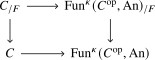 By virtue of Lemma 17.2.16, the Yoneda embedding above preserve
strictly \(\kappa\)-small colimits. The vertical functor on the right side
has a right adjoint (since \(\Fun^\kappa(C\catop,\An)\) is stable by pullbacks in \(\PSh(C)\))
hence commutes with all colimits that exist. More precisely this functor creates colimits:
since it is also conservative (being right fibration), any cocone in \(\Fun^\kappa(C\catop,\An)_{/F}\)
that become a colimit cocone in \(\Fun^\kappa(C\catop,\An)\) is a colimit cocone.
The dual version of Proposition 13.2.14 together
with Lemma 17.2.16 show that \(C_{/F}\) has strictly \(\kappa\)-small
colimits and that the projection to \(C\) preserves and detects them. In other words, condition (iii)
follows from condition (ii).
By virtue of Corollary 12.6.4, (i) follows from (iv).
Corollary 17.2.20. If \(C\) is a small category with strictly \(\kappa\)-small colimits, then we have \[ \Fun^\kappa(C\catop,\An)=\Ind_\kappa(C)\, . \]
Proposition 17.2.21. Let \(u\colon C\to D\) be a strictly \(\kappa\)-small colimits preserving functor between small categories with strictly \(\kappa\)-small colimits. Then the adjunction \[ u_!\colon\PSh(C)\rightleftarrows\PSh(D)\colon u^* \] restricts to an adjunction of the form \[ u_!\colon\Ind_\kappa{C}\rightleftarrows\Ind_\kappa{D}\colon u^* \] such that the right adjoint \(u^*\) commutes with \(\kappa\)-small colimits.
Proof
Since the property for a functor to preserve \(K\catop\)-indexed limits for any strictly \(\kappa\)-small category \(K\) is compatible with composition of functors, it is clear that \(u^*\) sends \(\Fun^\kappa(D\catop,\An)\) to \(\Fun^\kappa(C\catop,\An)\). The previous corollary thus tells us that \(u^*\) sends \(\Ind_\kappa(D)\) to \(\Ind_\kappa(C)\). The fact that \(u_!\) sends \(\Ind_\kappa(C)\) to \(\Ind_\kappa(D)\) follows from the fact that \(u_!\circ h_C=h_D\circ u\).
Definition 17.2.22. Led \(D\) be a locally small category with small colimits. An object \(x\) of \(D\) is \(\kappa\)-compact is the functor \[ \Hom_D(x,-)\colon D\to\An \] commute with strictly \(\kappa\)-small colimits. We denote by \(D^\kappa\) the full subcategory of \(\kappa\)-compact objects of \(D\).
A \(\kappa\)-presentable category is a locally small category with small colimits \(D\) such that there exists a small family \(E\) of \(\kappa\)-compact objects in \(D\) that generates \(D\) in the sense that a map \(u\colon y\to z\) in \(D\) is an isomorphism if and only in the induced map \[ u_*\colon\Hom_D(x,y)\to\Hom_D(x,z) \] for any \(x\colon E\).
Remark 17.2.23. By definition, \(\kappa\)-compact objects are stable under strictly \(\kappa\)-small colimits. One checks that \(\kappa\)-compact objects are stable under retracts as well. Indeed, if \(y\) is \(\kappa\)-compact and if there are maps \(s\colon x\to y\) and \(p\colon y\to x\) such that \(p\circ s=\id_x\), for any \(\kappa\)-filtered category \(I\) any \(I\)-indexed functor \(i\mapsto z_i\), the canonical map \[ \underset{i\colon I}{\colim}\, \Hom(x,z_i)\to \Hom(x,\underset{i\colon I}{\colim}\,z_i) \] is a retract of the isomorphism \[ \underset{i\colon I}{\colim}\, \Hom(y,z_i)\to \Hom(y,\underset{i\colon I}{\colim}\,z_i) \, . \]
Theorem 17.2.24. Let \(D\) be a \(\kappa\)-presentable category and let us choose a small generating family \(E\) of \(\kappa\)-compact objects in \(D\). We denote by \(C\) the smallest full subcategory of \(D\) stable under strictly \(\kappa\)-small colimits contining \(E\). Then \(C\) has the following properties:
(i) \(C\) is small;
(ii) all the objects of \(C\) as \(\kappa\)-compact;
(iii) there is a canonical identification of the form \(\Ind_\kappa(C)=D\).
Proof
The first assertion is a particular case of Lemma 17.2.2 The fact that \(D^\kappa\) is stable under strictly \(\kappa\)-small colimits follows right away from the definitions of \(\kappa\)-filtered categories and of \(\kappa\)-compact objects. By construction, \(C\) is a full subcategory of \(D^\kappa\), which proves assertion (ii).
Let \(i\colon C\to D\) be the embedding of \(C\) into \(D\). Since \(D\) is locally small with small colimits, the functor (defined a restricted Yoneda embedding) \[ i^*\colon D\to \PSh(C)\, , \quad y\mapsto\Hom_D(i\catop(-),y) \] has a left adjoint \[ i_!\colon\PSh(C)\to D \] equipped with an identification \[ i_!(h(x))=i(x) \] functorially in \(x\colon C\), with \(h\colon C\to\PSh(C)\) the Yoneda embedding of \(C\). We define a functor \[ \varphi\colon\Ind_\kappa(C)\to D \] as the composition of \(i_!\) with the full embedding of \(\Ind_\kappa(C)\) into \(\PSh(C)\). We observe that, for any object \(y\) of \(D\), the presheaf \(i^*(y)\) belongs to \(\Ind_\kappa(C)\). Indeed, by virtue of Proposition 17.2.19, it suffices to check that it preserves \(K\catop\)-indexed limits for any strictly \(\kappa\)-small category \(K\). This amounts to say that the functor \(i\) preserves strictly \(\kappa\)-small colimits, which holds by definition of \(C\). We thus get an adjunction of the form \[ \varphi\colon\Ind_\kappa(C)\rightleftarrows D\colon\psi \] where \(\psi\) induced by \(i^*\) through the previous observation. The functor \(\psi\) is conservative since \(E\) generates \(D\) and since isomorphisms can be detected objectwise in a functor category. Therefore, it suffices to prove that the functor \(\varphi\) is fully faithful. In other words, it suffices to prove that, for any object \(F\) of \(\Ind_\kappa(C)\), the unit map \[ \eta_F\colon F\to \psi\varphi(F) \] is an isomorphism. We observe that the functor \(\psi\) commutes with \(\kappa\)-filtered colimits since all objects of \(C\) are \(\kappa\)-compact in \(D\). Since the functor \(\varphi\) preserves colimits (being a left adjoint), this shows that the functor \(\psi\varphi\) preserves \(\kappa\)-filtered colimits. By definition of \(\Ind_\kappa(C)\), we know that \(F\) is a \(\kappa\)-filtered colimit of representable presheaves. Therefore, it suffices to prove that the unit map \(\eta_F\) is invertible when \(F=h(y)\) for some object \(y\) of \(C\). But then, for any object \(x\) of \(C\), we have \begin{align*} F(x) &=\Hom_C(x,y)\\ &=\Hom_D(i(x),i(y))\\ &=\psi\varphi(F)(x)\, . \end{align*}
Construction 17.2.25. Let \(C\) be a small category. We can apply the previous theorem to \(D=\PSh(C)\) with \(E\) the family of representable presheaves on \(C\). We define \(\langle C\rangle_\kappa\) as the smallest full subcategory of the category of presheaves on \(C\) containing representable presheaves and stable under strictly \(\kappa\)-small colimits. We then have a canonical equivalence \[ \Ind_\kappa(\langle C\rangle_\kappa)=\PSh(C)\, . \] Assume now that \(C\) has strictly \(\kappa\)-small colimits. We claim that the Yoneda embedding \[ h\colon C\hookrightarrow\langle C\rangle_\kappa \] has a left adjoint \[ \lambda\colon\langle C\rangle_\kappa\to C\, . \] Indeed, given an object \(X\) of \(\langle C\rangle_\kappa\), seen as a presheaf on \(C\), we have an associated right fibration \(p\colon C_{/X}\to C\), and for any term \(y\) of \(C\) we have \begin{align*} \Hom(X,h(y)) &=\Hom(\underset{C_{/X}}{\colim}\, h\circ p, h(y))\\ &=\underset{(C_{/X})\catop}{\lim}\,\Hom(h\catop\circ p\catop,h(y))\\ &=\underset{(C_{/X})\catop}{\lim}\,\Hom_C(p\catop,y)\\ &=\Hom_C(\underset{C_{/X}}{\colim}\, p, y) \end{align*} functorially in \(y\). This induces an adjunction \[ \lambda_!\colon\PSh(\langle C\rangle_\kappa)\rightleftarrows\PSh(C)\colon h_! \] or equivalently an identification \(h_!=\lambda^*\). Since \(h\) is fully faithful, its left adjoint \(\lambda\) is a localization (by Proposition 4.4.16) and thus the functor \(\lambda^*=h_!\) is fully faithful. By virtue of Proposition 17.2.21, the adjoints \(\lambda_!\) and \(\lambda^*\) restrict to an adjunction of the form \[ \lambda_!\colon\Ind_\kappa(\langle C\rangle_\kappa)\rightleftarrows\Ind_\kappa(C)\colon\lambda^*\, . \] In other words, we have an adjunction of the form \[ \lambda_!\colon\PSh(C)\rightleftarrows\Ind_\kappa(C)\colon h_!\, . \] This explains the following corollary.
Corollary 17.2.26. Let \(C\) be small category with \(\kappa\)-small colimits. Then \(\Ind_\kappa(C)\) has small colimits as well as small limits.
Proof
We have seen above that the full embedding \[ h_!\colon\Ind_\kappa(C)\hookrightarrow\PSh(C) \] has a left adjoint. Since \(\PSh(C)\) has small (co)limits, we conclude with Corollary 14.2.5.
Remark 17.2.27. If \(C\) is a small category with strictly \(\kappa\)-small colimits, then \(\Ind_\kappa(C)\) is \(\kappa\)-presentable. Indeed, it is locally small (as full subcategory of a locally small category) and has small colimits by the previous corollary. We know that \[ \PSh(C)\to\An\ , \quad F\mapsto\Hom(X,F) \] commutes with small colimits whenever \(X\) is a representable presheaf. Therefore, by Lemma 17.2.17, representable presheaves are \(\kappa\)-compact as objects of \(\Ind_\kappa(C)\). Since representable presheaves form a generating family of \(\Ind_\kappa(C)\) (because this is the case in \(\PSh(C)\) already), this proves that \(\Ind_\kappa(C)\) is \(\kappa\)-presentable. Therefore, Theorem 17.2.24 may be rephrased by claiming that a category is \(\kappa\)-presentable if and only if it is equivalent to a category of the form \(\Ind_\kappa(C)\) for some small category \(C\) with strictly \(\kappa\)-small colimits.
Corollary 17.2.28. Any \(\kappa\)-presentable category has small limits.
Proof
By virtue of Theorem 17.2.24, it suffices to prove that \(\Ind_\kappa(C)\) has small limits for any small category \(C\) with strictly \(\kappa\)-small colimits, which is documented in Corollary 17.2.26.
Definition 17.2.29. A category is \(\kappa\)-small if it belongs to the smallest full subcategory of \(\Cat\) containing \([n]\) for all \(n\colon\N\) and stable under strictly \(\kappa\)-small colimits.
Corollary 17.2.30. The category of \(\kappa\)-small categories is small. Any small category is a small \(\kappa\)-filtered colimit of \(\kappa\)-small categories.
Proof
The first assertion follows from Lemma 17.2.2. For the second one, we consider the equivalence \[ \PSh(\Delta)=\Ind_\kappa(\langle\Delta\rangle_\kappa) \] obtained by applying Theorem 17.2.24 with \(D=\PSh(\Delta)\) and \(E\) the family of representable presheaves. Therefore, given any small category \(C\), its nerve \(N(C)\) canonically is a small \(\kappa\)-filtered colimit of objects of \(\langle\Delta\rangle_\kappa\). Since the nerve is fully faithful, this implies that \(C\) is the colimit of the functor \[ \langle\Delta\rangle_\kappa\hookrightarrow\PSh(\Delta)\xrightarrow{\ac}\Cat\, . \] To conclude the proof, it suffices to observe the obvious fact that the latter takes values in the full subcategory of \(\kappa\)-small categories.
Proposition 17.2.31. Any category with strictly \(\kappa\)-small colimits has \(\kappa\)-small colimits.
Proof
Let \(C\) be category. Let \(C'=\Fun(C,\An)\catop\) and \(h\colon C\to C'\) be the Yoneda embedding. Let \(E\) be the full subcategory of \(\Cat\) with objects those small categories \(A\) such that \(A\)-indexed colimits exist in \(C\). Equivalently, a small category \(A\) belongs to \(E\) if and only if \(C\) is stable under \(A\)-indexed colimits in \(C'\). A direct application of Lemma 13.3.1 shows that \(E\) is stable under strictly \(\kappa\)-small colimits in \(\Cat\). Since \(E\) contains all strictly small colimits, it contains all \(\kappa\)-small categories.
Lemma 13.3.1 also yields right away:
Proposition 17.2.32. Any functor between categories with \(\kappa\)-small colimits that commutes with strictly \(\kappa\)-small colimits commutes with \(\kappa\)-small colimits.
Proposition 17.2.33. Any category with strictly \(\kappa\)-small colimits as well as small \(\kappa\)-filtered colimits has small colimits.
Proof
It follows from Corollary 17.2.30 and from Lemma 13.3.1 that any category with \(\kappa\)-small colimits as well as small \(\kappa\)-filtered colimits has small colimits. Therefore, it suffices to prove that any category with strictly \(\kappa\)-small colimits has \(\kappa\)-small colimits. Applying Lemma 13.3.1 once again, in order to conclude the proof, it suffices to observe finally that, since \([n]\) has a terminal object, any category has colimits indexed by \([n]\) for all \(n\colon\N\).
Proposition 17.2.34. If \(A\) is \(\kappa\)-small then so is \(A\catop\).
Proof
The assignment \(A\mapsto A\catop\) is an equivalence of categories. Therefore, the full subcategory \(E\) of \(\Cat\) spanned by those small categories \(A\) such that \(A\catop\) is \(\kappa\)-small is stable under \(\kappa\)-small colimits in \(\Cat\). It contains \([n]\) for all \(n\) since \([n]=[n]\catop\). Therefore, any \(\kappa\)-small category belongs to \(E\).
Corollary 17.2.35. If \(C\) has strictly \(\kappa\)-small colimits, then \(\Ind_\kappa(C)\) is the full subcategory of \(\PSh(C)\) spanned by presheaves \(F\colon C\catop\to\An\) that preserve \(\kappa\)-small limits.